Annual Stairlift Running Costs in the UK: 2026 Guide
What if electricity is the easiest part of estimating a stairlift’s yearly cost? It’s natural to wonder how much a stairlift might add to your household bills, especially when servicing or an unexpected repair could also affect your budget. The stairlift running costs per year UK households need to plan for can include more than the electricity used to keep it working.
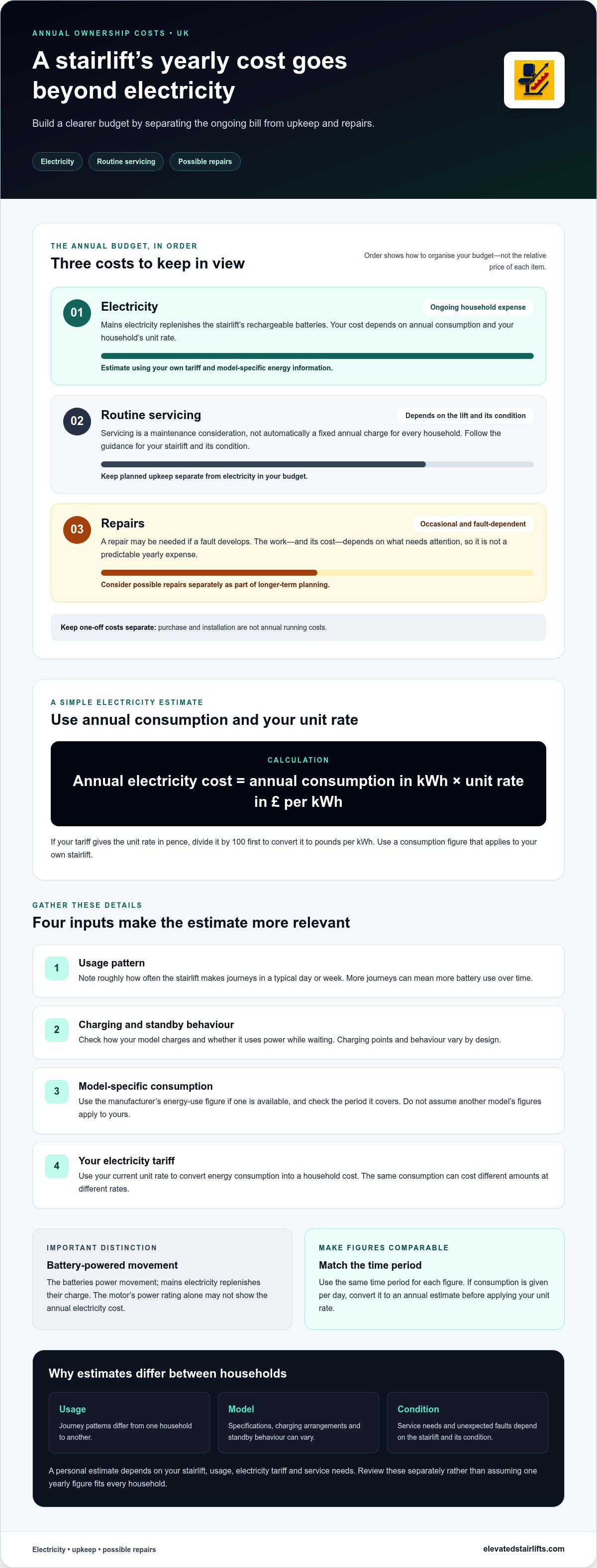
Electricity use is often modest because rechargeable batteries are topped up from the mains, but your tariff and how often the lift is used affect the bill. Upkeep is separate: routine servicing, repairs and battery replacement can all contribute over time, although each household’s needs differ.
This 2026 guide explains the main parts of annual running costs and how to estimate electricity expenses using your own unit rate and usage pattern. It also covers how maintenance and potential repairs fit into longer-term budgeting, so you can build a more realistic picture of ownership without assuming every stairlift or household is the same.
Table of Contents
What do annual UK stairlift running costs include?
Planning for a stairlift means looking beyond the initial purchase and installation. The stairlift running costs per year UK households may need to budget for include electricity, any routine servicing they arrange and occasional repairs. These costs arise in different ways: electricity is an ongoing household expense, while maintenance and repair work depend on the stairlift and its condition.
Purchase and installation are separate, one-off costs, not annual running costs. Keeping them separate makes it easier to understand what ownership may involve over time. For a neutral overview of how stairlifts work and the differences between types, see Stair lift.
Which expenses belong in a yearly stairlift budget?
Start with electricity. A stairlift draws power to charge its battery, and the annual cost depends on its actual consumption and your household’s electricity unit rate. You can estimate this using your tariff and a relevant energy-use figure, as explained later in this guide.
Then consider upkeep. Routine servicing is a maintenance consideration, not automatically a fixed annual charge for every household. The appropriate schedule can depend on the stairlift, its condition and the manufacturer’s guidance. Repairs are different: they’re occasional costs if a fault develops, and the work required depends on what needs attention. Professional servicing and repair support can form part of your ownership plan, without assuming every household will need the same work.
Why is there no single annual figure for every household?
Usage patterns vary. One household may make a few journeys each day, while another uses the stairlift more often. Charging and standby behaviour can also vary by model, so electricity estimates won’t necessarily be the same. The stairlift’s specifications and charging arrangement matter too.
Your tariff is another key factor. The same electricity consumption will cost different amounts at different unit rates. Service needs can also change according to the stairlift’s age and condition, while an unexpected fault can’t be treated as a predictable yearly expense.
General guidance can help you identify likely cost categories, but a personal estimate depends on your stairlift, usage, electricity tariff and service needs. Start with recurring electricity, then consider routine upkeep and possible repairs separately as part of longer-term budgeting.
How does a stairlift use electricity, and what affects its consumption?
A stairlift’s motor is generally powered by rechargeable batteries, while mains electricity supplies the charge. Household electricity use is therefore linked to keeping the batteries charged, not simply to the time the lift is moving. The exact arrangement depends on the model, so a single wattage or journey count isn’t a universal guide.
The rail, drive mechanism and other components determine how the lift moves along the staircase. For a technical overview of how a stairlift is constructed, Designing Buildings Wiki explains some of its design and mechanical elements. To estimate your own electricity use, the manufacturer’s information for your particular model is more useful.
Do stairlifts run on batteries or mains electricity?
The batteries power movement, and mains electricity replenishes their charge. The charging points and charging behaviour depend on the stairlift’s design. Some models may charge when parked at a designated point, while others use a different arrangement. Follow the manufacturer’s instructions to understand how your lift should charge, rather than assuming all models work alike.
This distinction explains why the motor’s power rating alone may not tell you the annual electricity cost. The batteries’ charging needs and any electricity used while the lift is waiting or on standby can affect total consumption. Use product-specific documentation where available, and don’t apply another model’s figures to your own.
Which everyday habits influence electricity use?
More journeys can mean more battery use over time and, in turn, more charging demand. But the relationship isn’t a fixed cost per trip: charging patterns, standby behaviour and product specifications all play a part. Your household’s routine is a useful input, not a substitute for model-specific consumption information.
For a closer estimate of stairlift running costs per year UK households may face, gather these details:
Usage: roughly how often the stairlift makes journeys in a typical day or week.
Charging and standby behaviour: how the model charges and whether it uses power while waiting.
Consumption information: the manufacturer’s energy-use figure, if provided, and the period it covers.
Electricity tariff: your current unit rate, which you’ll use to convert energy consumption into a household cost.
Use the same time period for each figure. If the manufacturer gives consumption per day, convert it to an annual estimate before applying your unit rate. If you’re planning installation or ongoing care, explore stairlift installation and support as part of your household’s longer-term planning.
How can you calculate your stairlift’s annual electricity cost?
Once you have an annual energy-use figure for your stairlift, the calculation is straightforward: annual electricity cost = annual consumption in kWh × your electricity unit rate in £ per kWh. If your tariff shows the rate in pence, divide it by 100 first to convert it to pounds per kWh.
Make sure the consumption figure and calculation cover the same period. Convert daily consumption to an annual figure, or multiply a monthly estimate by the number of months in a year. This makes your calculation easier to check and update if your tariff or household usage changes.
What information do you need for a personal estimate?
Look for energy-consumption guidance in the stairlift’s product documents or manufacturer information. Check whether the figure is for a day, month or year, and what usage pattern it assumes. Measuring the stairlift’s consumption over a representative period may also help you estimate costs based on your household’s actual routine.
Next, find the electricity unit rate on your latest bill or tariff information and note the date you checked it. Your rate may change, so a calculation is more useful when its tariff date is clear. If the model’s documents give a range rather than one figure, calculate using both the lower and upper estimates to create a household-specific range.
Annual consumption: [stairlift use in kWh per year]
Unit rate: [your tariff in £ per kWh]
Calculation: [annual kWh] × [£ per kWh] = [estimated annual electricity cost in £]
For a rate listed in pence, use [pence per kWh] ÷ 100 to find the rate in pounds. This estimate covers the stairlift’s electricity use, not servicing or repairs.
How should you compare stairlift electricity use with appliances?
Compare annual energy use in kWh, rather than wattage alone. Watts describe how much power a device draws at a particular moment; kWh measures energy used over time. An appliance with a higher wattage may run for only a short time, while another may use less power but operate or remain on for longer.
Appliance comparisons can give a general sense of scale, but they’re only fair when the time period and operating assumptions are clear. A figure based on one model or routine shouldn’t be treated as universal. For a realistic estimate of stairlift running costs per year UK households may face, use model-specific consumption information, your own usage pattern and a dated tariff. The standing charge on your electricity bill is a separate household charge, so don’t include it in the stairlift calculation as though the lift caused it.
Are electricity bills the only yearly cost to consider?
No. Electricity is only one part of the stairlift running costs per year UK households may want to plan for. A low electricity estimate doesn’t represent the full cost of ownership: routine servicing and occasional repairs are separate considerations. Neither should be treated as the same fixed annual charge for every stairlift.
What is the difference between servicing and repairs?
Servicing is planned attention intended to support safe, reliable operation. The recommended schedule can depend on the stairlift and its condition, so follow the manufacturer’s guidance rather than assuming a universal annual requirement. Repairs address a particular fault. The work needed, and therefore the cost, depends on what has gone wrong. For more detail on planned upkeep, read our guide to stairlift maintenance.
How can owners plan for less predictable costs?
Review the manufacturer’s guidance and consider the stairlift’s age, condition and any known faults when organising your household budget. You might choose to set aside a personal allowance for possible repairs. This is a budgeting decision, not a quoted yearly charge or a prediction that a fault will occur.
If a problem arises, the repair required depends on its cause and the work involved. ElevatedStairlifts provides professional stairlift repair and breakdown support. For help with maintenance or a fault, get support with stairlift servicing and repairs.
How can you manage stairlift running costs and arrange ongoing support?
A short yearly review can help you keep stairlift costs clear and plan for ongoing care. The aim isn’t to predict every expense, but to update your estimate as household circumstances and the stairlift’s condition change. For a useful picture of stairlift running costs per year UK households may face, consider electricity alongside service needs and any known faults.
What should you review when budgeting for the year ahead?
Use this checklist to refresh your estimate:
Electricity tariff: Check your current unit rate and update the calculation if your tariff has changed. Record the date, as rates can vary over time.
Usage pattern: Revisit how often the stairlift is used. Changes to household routines may affect your consumption estimate.
Service guidance: Review the manufacturer’s recommendations for your model and note any servicing carried out.
Performance: Record unusual operation or changes you notice, such as new noises or inconsistent movement, so you can explain them if support is needed.
Keep service records and your latest electricity estimate together. They give you a straightforward reference point for next year, without treating a general estimate as a guaranteed bill or assuming the stairlift will need a particular repair.
When might professional stairlift support be helpful?
Routine maintenance provides planned attention to the stairlift’s ongoing care needs. The appropriate work and timing depend on the model, its condition and manufacturer guidance. Servicing can support informed upkeep, but it can’t promise lower electricity bills or prevent every breakdown.
If the stairlift behaves unusually or stops working, professional repair support can help address the fault. The work required depends on the problem, so describe what you’ve noticed rather than assuming a particular cause. ElevatedStairlifts provides installation, servicing and breakdown support, helping households plan for care as well as day-to-day use.
Whether you’re considering a new stairlift or arranging ongoing care for one already in your home, you can explore stairlift installation, maintenance and repair support.
Plan ahead with confidence
A clear estimate of stairlift running costs per year UK households may face starts with your stairlift’s electricity use and your current unit rate. Keep that calculation separate from servicing and repairs: maintenance needs depend on the model and its condition, while repair work depends on the fault.
Review your tariff and usage pattern each year, and keep service records and notes about any changes in how the stairlift operates. This gives you a more useful household budget without assuming every home has the same costs or needs.
ElevatedStairlifts provides professional installation for Thyssen Homeglide and Stannah 260 stairlifts, alongside routine maintenance and breakdown repair support across the UK. If you’re considering a stairlift, request a free, no-obligation quote by sending staircase photos via WhatsApp or email.
Explore professional stairlift installation, maintenance and repair support and take the next step at a pace that feels right for your home.
Frequently Asked Questions
How much does it cost to run a stairlift per year in the UK?
Electricity is estimated to cost around £5 to £20 a year, but that isn’t the full cost of ownership. Your actual bill depends on the stairlift’s energy consumption, how it’s used and your electricity unit rate. Routine servicing and repairs are separate budget considerations, depending on the model, its condition and service needs. Treat the electricity estimate as a guide, not a guaranteed total for stairlift running costs per year in the UK.
Does a stairlift use much electricity?
No, a stairlift generally uses a modest amount of electricity. It moves using rechargeable batteries, which are charged from the mains, so household electricity use is mainly related to charging rather than simply the time spent travelling. Estimates suggest stairlifts use around 20 to 40 kWh a year, though consumption depends on the model and use. Check the manufacturer’s information for a more relevant figure for your stairlift.
Do stairlifts need to be switched off when they are not being used?
Follow the instructions for your particular stairlift, as charging and standby arrangements vary between models. Some lifts need to be parked at a designated charging point, so switching one off or leaving it in the wrong position could affect its charging routine. If you’re unsure how your model should be left between journeys, refer to its user manual or manufacturer guidance rather than applying a general rule.
How do I calculate my stairlift’s yearly electricity cost?
Multiply the stairlift’s annual electricity consumption in kilowatt-hours (kWh) by your household’s unit rate in pounds per kWh. Use: annual kWh × £ per kWh = estimated yearly electricity cost. Check that the consumption figure covers a full year, or convert it from a daily or monthly period first. Note when you checked your tariff, since unit rates can change. The standing charge is separate and isn’t stairlift-specific.
Are stairlift servicing and repairs included in annual running costs?
They can be part of your wider ownership budget, but they’re separate from the electricity estimate. Servicing is planned maintenance, with the schedule depending on the stairlift, its condition and manufacturer guidance. Repairs are needed if a fault develops, and the work required depends on the problem. Keeping these items separate helps you avoid treating a general electricity estimate as the total yearly cost, or assuming every household will need the same maintenance.
Is a stairlift cheaper to run than a washing machine?
It depends on the stairlift’s annual consumption and how often the washing machine is used, so there isn’t one reliable comparison for every household. Compare annual energy use in kWh rather than wattage alone. A washing machine’s consumption varies with its model, cycle and usage, while a stairlift’s charging and standby behaviour vary by model too. Use manufacturer information and your own usage patterns to make a like-for-like comparison.


Comments