Stairlift Suitability Assessment: Is One Right for You?
What if a stairlift fits your staircase but still isn’t the safest or most practical choice? A stairlift suitability assessment looks beyond the stairs alone. The person needs to be able to get on and off the seat and use the controls, while the staircase and the way the household uses it also need to be considered.
If you’re unsure about transfers, worried that a narrow or awkward staircase could rule out installation, or wondering whether another mobility option would be more appropriate, you’re not alone. The answer depends on the person’s needs as well as the layout and everyday use of the home.
This checklist explains the main factors that shape suitability, from mobility and daily routines to staircase layout. It also suggests what to prepare and ask during a professional assessment. If a stairlift may not be the right fit, the conversation can help you understand why and consider appropriate next steps without feeling rushed.
Table of Contents
Stairlift suitability assessment: what does it need to establish?
A stairlift may be suitable when the person, staircase and household routine work together, and the user can operate it safely. A stairlift suitability assessment brings these factors into one practical discussion. Rather than relying on a single measurement or diagnosis, it considers how the lift could fit into everyday life, including getting on and off and maintaining access around the home.
What does a stairlift suitability assessment consider?
The assessment should connect the user’s mobility and transfer needs with the staircase layout and the way the household uses the stairs. A professional can consider the route and discuss how the person would approach, use and leave the seat. The Stair lift overview explains the basic concept and different types, but deciding what may suit a particular person and home requires individual consideration.
There isn’t one measurement or diagnosis that automatically gives a yes-or-no answer. A staircase feature may affect the possible route, while the user’s needs may raise questions about operation or support. The aim is to understand how these details fit together and identify any concerns that need clarification before a decision is made.
Who should take part in the assessment?
Where possible, the intended user should describe what feels difficult, what they hope to manage more independently and what would help them feel comfortable. A family member or carer can join if the user wants support or if assistance is part of the current routine. Their observations may explain practical details, but the user’s preferences and comfort should remain central.
An assessment informs a recommendation. It doesn’t guarantee that a stairlift will be suitable or that a particular solution will be advised. If questions about safe use or assistance remain, ask what they mean for daily life and whether further advice may be helpful. Take the time you need to understand the recommendation before deciding what to do next.
It helps to separate three related decisions. A suitability assessment considers whether the person and home may be a match. Installation planning looks at how a recommended option could be fitted to the staircase. A quote sets out the proposed work and its price. These steps inform one another, but answer different questions. A quote or possible installation plan isn’t proof that the lift will meet the user’s needs.
Use the checklist in this guide to prepare for a clear, balanced conversation. Share relevant details, ask about any limitations and consider the options without feeling pressured to proceed.
Personal mobility and transfers: can the user operate a stairlift?
Personal suitability is about what the intended user can comfortably manage, not their age or diagnosis. During a stairlift suitability assessment, focus on each practical step: approaching the seat, sitting down, securing themselves, using the controls and standing up at the other end. Being able to walk on the flat, for example, doesn’t automatically show whether these transfers will feel manageable.
Explain any factors that affect these tasks. Balance, pain, fatigue, restricted movement, memory or hand control may be relevant if they change how the person gets on, stays seated or operates the lift. The purpose isn’t to make assumptions, but to describe the user’s circumstances and explore what support or options may be appropriate.
Can the user transfer on and off the seat comfortably?
Consider whether the user can approach the seat and turn into position, then sit down and rise without feeling rushed or unsteady. Think about what happens on a more difficult day, too. If someone currently needs help, explain what assistance they rely on. Needs may change over time, so ask how that could affect day-to-day use.
Comfort matters as much as completing the steps. Ask the user how they feel about using the seat, footrest and safety belt, and whether any part of the process causes concern. Don’t assume they’ll be comfortable simply because a lift can be fitted to the staircase.
Can the user manage the controls and journey?
Discuss whether the controls seem reachable and understandable to the intended user, including any difficulty gripping or pressing them. Consider whether they can remain comfortably seated for the journey and maintain a posture that feels manageable. If memory or concentration affects operation, describe what happens in familiar daily situations rather than relying on a broad label.
Ask the assessor to explain relevant options in plain, practical language. A discussion informed by a comprehensive assessment may also help clarify whether the user’s needs call for further consideration of other solutions. If you’re unsure, ask what assistance would be needed and how the recommendation relates to the person’s comfort and independence.
The user should have room to express preferences, even if a family member or carer is helping explain their needs. Their comfort should guide the conversation. To learn more about the installation service, you can read about stairlift installation, then raise any personal mobility questions before deciding on a next step.
Staircase suitability: what can the home layout support?
A staircase may look straightforward, but the usable route depends on more than its overall shape. During a stairlift suitability assessment, a professional needs to consider the staircase and the space needed to get on and off at each end. This is separate from personal suitability: even if the user can manage the lift, the home layout must allow a practical route and access.
Which staircase details should be checked?
Look at the layout in everyday terms, rather than trying to assess the measurements yourself. Note whether the stairs are straight or turn, where the landings are and what is close to the route. A doorway that opens onto the stairs, a radiator, a window or a low ceiling could affect the proposed rail path or available space. Handrails and nearby furniture may also matter.
These observations are useful to share, but don’t try to decide whether the staircase has enough clearance yourself. An installer needs to confirm the dimensions and practical clearances before recommending a layout. Photos may help start a conversation, but they can’t establish that an installation will be suitable.
How do straight and curved staircases affect the options?
A straight flight may allow a simpler rail route, while bends or changes in direction can require different rail planning. A staircase with a turn isn’t automatically unsuitable, and a narrow-looking staircase doesn’t rule out every option. The usable width, shape and surrounding space all matter, so suitability needs to be confirmed for the particular home.
If the stairs are narrow or the hallway is tight, the guide to stairlift options for narrow stairs and hallways may help you understand the layout questions to raise. Treat it as background information, not confirmation that a specific lift will fit.
Consider access beyond the rail itself. At the top and bottom, is there room for the user to approach, transfer and move away from the seat? Could an open door, landing or usual household route make entry or exit awkward? A lift may follow the staircase but still affect how people pass through the hallway or reach rooms on either floor.
Describe how the stairs and landings are used during a normal day, including which doors are often open and what needs to remain accessible. This helps the professional consider the layout in context and explain any limitations or options. The goal is to understand what the home can support, not to force a recommendation where the route or everyday access doesn’t work.
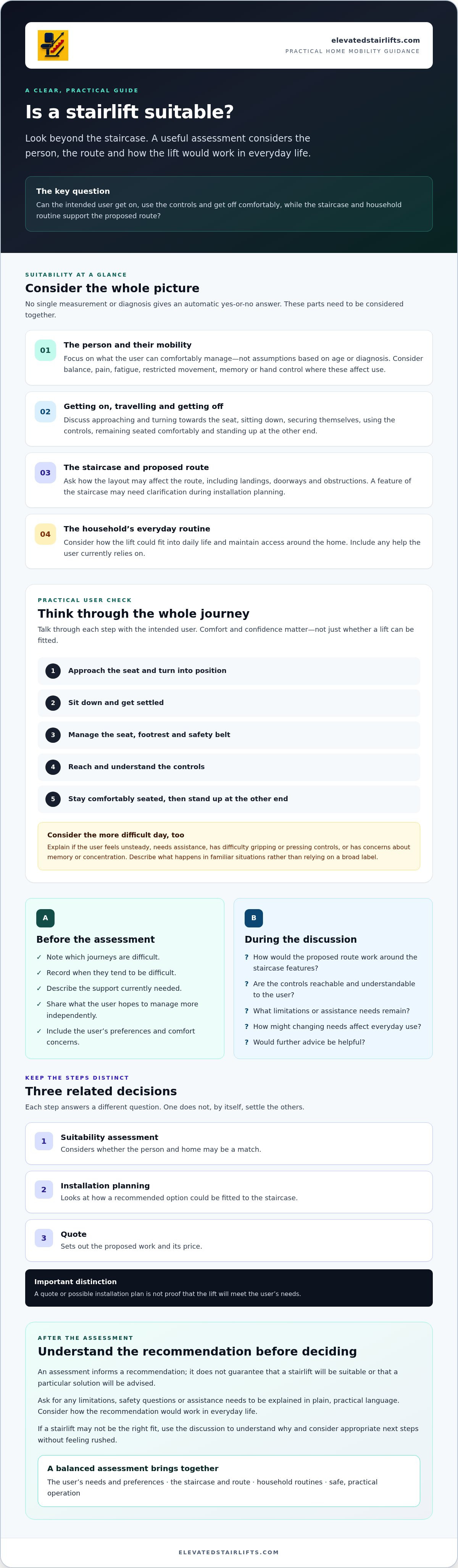
Suitability assessment checklist: what should you prepare and ask?
A little preparation can make a stairlift suitability assessment more useful. You don’t need to measure the stairs or decide whether a lift will fit. Instead, gather everyday details that help the professional understand what’s difficult, what matters to the user and what you need clarified before making a decision.
Before: collect the details that matter
Think about a typical day, including which journeys are difficult and when they tend to happen. The stairs may feel manageable at one time but harder when the user is tired or in pain. Note the practical impact rather than trying to diagnose the cause.
Which flight or part of the route is challenging, and what makes it difficult?
What help is currently needed with walking, transfers or getting between floors?
Which rooms need to remain easy to reach, and what preferences or concerns does the user want heard?
Are there doors, radiators or other visible obstacles near the stairs? Photos may help show the layout.
Share photos if they’re useful, but don’t treat them as a substitute for professional confirmation of the layout.
During: ask how the recommendation fits
Use your notes to keep the conversation focused on daily use. Ask the assessor to explain how the proposed option relates to the user’s transfers and use of the controls, as well as the staircase and access at each end. If an explanation feels too technical, ask for it in plain language.
How does the recommendation address the user’s ability to get on and off, and operate the lift?
Are there limitations, assistance needs or practical compromises to understand?
How might doors, landings or household routines affect access?
If a stairlift isn’t the best fit, what other appropriate options should we consider?
After: take time to weigh the advice
Before deciding, check that you understand what’s being recommended, what it would and wouldn’t solve, and whether the user feels comfortable with it. Ask for clarification if something is unclear or if the proposal doesn’t seem to match the needs you described. Compare the recommendation with the household’s routine rather than feeling you must proceed straight away.
If you’d like to explore installation options, you can request a free, no-obligation quote by sending staircase photos via WhatsApp or email. A quote is separate from an assessment, so use it to understand the proposed work, not as a substitute for discussing personal suitability.
After the assessment: compare the recommendation and choose your next step
An assessment gives you information to weigh, not a decision you have to accept immediately. Compare the recommendation with the user’s priorities: comfort, reaching the floors they need to use and how the option would fit the household’s routine. A stairlift suitability assessment is most useful when its findings make both the benefits and limitations clear.
Consider what everyday use would involve. Would the user feel comfortable with the proposed arrangement? Would they still need help at particular points, or could doors and shared spaces affect access? If an important need seems unanswered, ask the assessor how the recommendation addresses it. Request clarification before deciding.
How do you compare a stairlift with other next steps?
There’s no useful universal score for deciding whether a stairlift is right. The next step depends on the person’s needs and the home. If the assessment suggests a stairlift may not be suitable, ask a qualified professional which alternatives are appropriate and why. You can also read this guide to stairlift solutions for UK homes to explore broader options, then discuss what may apply to your circumstances.
Before moving forward, make sure you understand the recommendation, any assistance the user may still need and any practical compromises involved. If those points remain unclear, pause and ask. A clear explanation should help you compare options without feeling pushed towards a particular outcome.
What happens if a stairlift appears suitable?
If the findings support a stairlift, the next discussion can cover which option may suit the staircase and user, how installation would be planned and what ongoing support is available. These decisions should follow confirmed assessment findings. A product name alone doesn’t establish suitability for a particular person or home.
ElevatedStairlifts installs stairlifts, including the Thyssen Homeglide and Stannah 260, subject to suitability. The business also provides stairlift servicing, repair and breakdown support. If you’re ready to learn about the fitting process, read this stairlift installation guide. You can then consider whether the proposed installation and support meet the user’s needs and decide on a next step in your own time.
Take the next step with confidence
A stairlift suitability assessment should consider more than the staircase. The user’s ability to transfer, operate the lift and feel comfortable using it matters as much as the layout and the household’s everyday access needs. A professional recommendation can help clarify whether a stairlift may be suitable, but it’s reasonable to ask about limitations or other options before deciding.
If a stairlift appears to fit your needs, installation planning can confirm the proposed arrangement. ElevatedStairlifts installs the Thyssen Homeglide and Stannah 260, subject to suitability, and provides stairlift servicing and breakdown support. You can request a free, no-obligation quote by sending staircase photos via WhatsApp or email. A quote isn’t a substitute for discussing the user’s needs, but it can help you explore the installation proposal without pressure.
Request a free, no-obligation stairlift quote when you’re ready. Take your time, ask the questions that matter and choose the next step that feels right for the person and the home.
Frequently Asked Questions
What happens during a stairlift suitability assessment?
A stairlift suitability assessment considers whether the user, staircase and daily routine could work together safely and practically. The professional will discuss how the user manages transfers and controls, and consider the staircase layout, landings and possible obstacles. The conversation should help clarify whether a stairlift may be appropriate and what questions remain. It informs a recommendation, but doesn’t guarantee that a stairlift or a particular model will be suitable.
Can a stairlift be fitted to any staircase?
No, not every staircase will support a suitable stairlift installation. Its shape, usable width, turns, landings and nearby features such as doors, radiators or low ceilings can affect the possible route. A narrow staircase or one with a turn isn’t automatically unsuitable, but photos or a visual check alone can’t confirm fit. An installer needs to assess the specific layout and practical clearances before advising what may work.
How do I know if I can use a stairlift safely?
Consider whether you can approach the seat, sit down, secure yourself, remain comfortably seated, use the controls and stand up at the other end. Pain, balance, fatigue, restricted movement or difficulty using your hands may affect one or more of these tasks. Discuss your situation with the assessor rather than relying on age or diagnosis alone. If you’re concerned about clinical or mobility needs, ask a suitable health professional, such as an occupational therapist, for advice.
Does a stairlift assessment consider the user’s medical condition?
An assessment can take relevant health information into account, particularly where a condition affects movement, balance, memory, comfort or the ability to operate the lift. A diagnosis on its own doesn’t determine suitability; what matters is how the person manages the practical tasks involved and whether they need assistance. Explain any changes or concerns you want considered. An installer can discuss practical suitability, but this isn’t a medical diagnosis or substitute for clinical advice.
What should I prepare for a stairlift home assessment?
Note which stairs are difficult, what makes them challenging and whether this changes at different times of day. Record any transfer or assistance concerns, rooms that need to remain accessible and questions the user wants answered. Photos may help show the staircase, nearby doors and visible obstacles, but don’t try to measure or decide whether a lift will fit. Invite a family member or carer if the user would find their support helpful.
What if a stairlift is not suitable for my home or mobility needs?
If a stairlift isn’t recommended, ask the professional to explain why and which needs or layout issues affect that conclusion. You can discuss other appropriate home access or mobility options with a qualified professional. The best next step depends on the user’s circumstances, so don’t feel you have to choose a solution before understanding its practical benefits and limitations. If assistance or health needs are involved, seek advice from an appropriate health professional too.
Is a stairlift assessment the same as an installation survey?
Not necessarily. A suitability discussion considers whether the person, home layout and routine may be compatible with using a stairlift. Installation planning focuses on how a recommended option could be fitted, while a quote sets out the proposed work and price. These steps are related, but answer different questions. Ask what the appointment or discussion covers, and make sure personal suitability concerns are addressed rather than assuming installation planning settles them.
Comments