Choosing Straight Stairlifts: The 2026 UK Home Mobility Guide
Accounting for approximately 70% of all domestic installations across the UK, straight stairlifts remain the country's most reliable and practical home mobility solution. Even so, wondering whether your own staircase can accommodate one is completely natural. It is easy to worry about losing your independence, fear that heavy machinery might damage your walls, or feel confused about the real differences between straight and curved rails. You shouldn't have to dread climbing the stairs in a house you love.
This 2026 guide shows you how to select the perfect straight stairlift for your home whilst understanding the key differences in models, slimline options, and installation requirements. Ahead, we will walk you through how modern designs preserve precious hallway space and restore effortless, safe access to your upper floor without any stressful upheaval.
Table of Contents
What are Straight Stairlifts and Are They Right for Your Home?
A straight stairlift is a motorised mobility system engineered for stairs that run in a single, uninterrupted line from top to bottom. Because British homes frequently feature uniform flights without mid-level landings or turns, straight stairlifts represent the most straightforward, practical, and cost-effective mobility solution available. They fit neatly into place without structural alterations, providing an efficient turnaround.
To qualify for a straight rail, your staircase must have a "true" straight run. This means no intermediate quarter-landings, no gentle curves, and no fan-shaped winder steps at either end. Beyond solving physical obstacles, installing a straight rail delivers profound psychological relief. It eliminates everyday apprehension, helping to restore autonomy amongst family members who wish to move freely without relying on constant supervision.
Key Components of a Straight Rail System
A standard straight lift relies on three fundamental elements:
The aluminium track: A common misconception is that rails anchor to the wall. Instead, durable brackets bolt directly into your wooden stair treads, protecting delicate plasterwork, skirting, and wallpaper.
The motorised carriage: High-torque drive systems deliver gentle acceleration and gradual deceleration. This steady start and stop behaviour prevents sudden jolting, ensuring complete joint comfort.
Intelligent battery back-up: The carriage runs on low-voltage internal DC batteries that continuously top up from the mains supply. If your home experiences a sudden power cut, the lift retains enough stored charge to complete multiple full journeys safely.
Common Signs You Need a Straight Stairlift
Recognising when to adapt your living space isn't always obvious. Everyday warning signs often appear gradually:
Fatigue and breathlessness: Finding yourself resting halfway up the flight, or feeling drained once you reach the top landing.
Persistent joint discomfort: Experiencing sharp knee or hip pain, particularly amongst those managing arthritis or reduced cartilage.
Unbalanced movement: Clinging tightly to both the banister and the wall for reassurance during descent.
Reluctance to move: Planning your entire day downstairs just to avoid climbing the flight.
Investing in a straight rail removes these physical hurdles, enabling you to remain comfortable and secure in your favourite family home rather than facing the emotional and financial strain of downsizing.
Straight vs Curved Stairlifts: A Practical Comparison
The core distinction between rail types comes down to track engineering. Because straight stairlifts run along uniform, pre-manufactured aluminium sections, they don't require bespoke factory bending. In contrast, curved tracks demand custom fabrication to map the exact contours of individual stairs. This makes standard straight designs significantly more affordable for British households, cutting manufacturing wait times from several weeks down to off-the-shelf readiness. When funding larger home adaptations through UK Disabled Facilities Grants, councils often review whether a simpler straight rail configuration meets the resident's mobility needs before approving complex bespoke works.
Installation schedules reflect this manufacturing difference. A professional engineer can securely assemble, wire, and test a straight track in just two to four hours. Custom curved installations, however, regularly span one or two days. Selecting modern slimline stairlifts also ensures that the apparatus hugs the skirting closely, leaving ample clearance for ambulant family members to walk past without restriction.
When a Straight Lift is Not Enough
Some properties disguise structural complexities. Even if your staircase appears mostly direct, slight architectural shifts might rule out a standard straight rail:
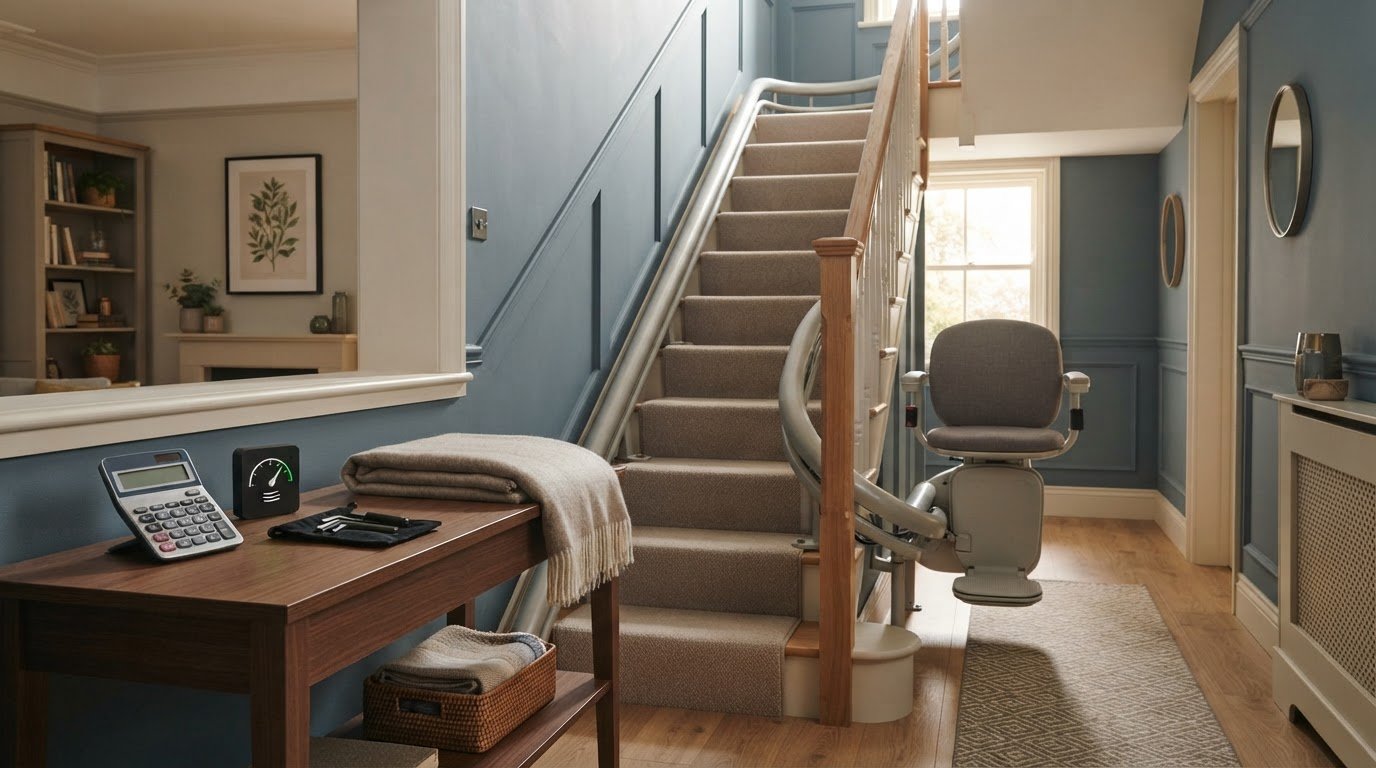
Intermediate landings: A central landing connecting two distinct flights usually requires either a bespoke continuous curve or two separate straight units.
Winder steps: Stairs that fan or flare out at the top or bottom cannot support a straight rail without leaving unmanageable gaps.
The transfer problem: If a straight rail stops shy of your bedroom entrance, stepping off onto an uncarpeted landing might introduce a slip hazard.
Evaluating tailored stairlift solutions for UK homes helps you identify whether your layout requires specialised bends to guarantee safe, level dismounting.
Space-Saving Features for Narrow Hallways
Standard UK properties, especially Victorian terraces and 1930s semis, frequently feature compact entryways under 800 mm wide. Folding footrests, folding armrests, and swivelling seats retract when parked, keeping the walking thoroughfare open. For individuals who struggle to bend their knees or hips, perch seats offer an upright posture that cuts down forward projection even further. Discovering dedicated stairlifts for narrow stairs ensures that tighter stairwells stay practical for everyone. If you'd like a quick, pressure-free assessment of your hallway dimensions, you can easily share staircase photos with ElevatedStairlifts for honest, no-obligation advice.
Comparing Top Models: Thyssen Homeglide vs Stannah 260
Selecting the ideal carriage requires balancing mechanical simplicity against aesthetic customisation. While straight stairlifts are typically fitted with single-rail tracks, many UK households weigh standard straight engineering against versatile twin-rail options when evaluating their long-term mobility. Consult independent consumer resources like Which? stairlift brand and reliability reviews to confirm how both TK Elevator and Stannah perform across thousands of domestic cycles. Both manufacturers comply with strict BS EN 81-40 safety directives, featuring anti-entrapment pressure sensors on the footplate and chassis that stop the carriage immediately if an obstacle is met.
The Thyssen Homeglide Advantage
Widely regarded as the dependable workhorse of the industry, the Thyssen Homeglide is engineered specifically for uninterrupted staircases. It features an impressive weight capacity of up to 160 kg (25 stone), making it exceptionally sturdy. The carriage uses an intuitive, ergonomic joystick that glides smoothly under minimal palm pressure, providing effortless operation for individuals with diminished hand strength. Its aluminium rail fixes close to the wall, whilst the seat and footrest fold away to a slim profile under 390 mm. Seasoned Thyssen Homeglide installers frequently favour this model for its plug-and-play reliability and low maintenance requirements.
The Versatility of the Stannah 260
Known across Britain for iconic engineering, the Stannah 260 twin-rail system offers tailored comfort and superior upholstery choice. While Stannah manufactures dedicated straight tracks, the 260 chassis provides an adaptable modular setup often favoured where stair transitions require extra customisation. Key highlights include:
Ergonomic tiller control: Designed alongside occupational therapists, the light-touch direction paddle can be operated using a single finger, wrist, or side of the hand; a favourite amongst those managing severe arthritis.
Bespoke finishes: You can select from varied upholstery colours and fabrics to blend seamlessly into your hallway's existing décor.
Compact folding geometry: Retractable footplates and close-fitting twin rails ensure the unit preserves maximum walking clearance across narrower landings.
Interlocked seatbelt: The motor refuses to engage until the buckle securely fastens, adding reassuring peace of mind during transit.
How to Measure and Prepare for Your Stairlift Fitting
Preparing your home for a straight rail is simpler than most people expect. Because straight stairlifts require no custom bends, initial spatial checks follow a clear, predictable pattern. You can easily complete the initial evaluation yourself using a standard tape measure:
Step 1: Check rail run length: Measure the direct line from the nose of the top landing down to the ground floor.
Step 2: Inspect lower obstructions: Verify that opening doorway arches, hall radiators, or under-stair cupboard doors leave at least 400 mm of clear landing space beyond the bottom step.
Step 3: Confirm staircase width: Ensure the narrowest point between the wall and the banister provides at least 680 mm to 740 mm of clear space.
Step 4: Locate mains electricity: Check that an ordinary 240V domestic power socket sits within a couple of metres of either the top or bottom of the stairs to power the continuous battery-charging system.
The 'Quote by Photo' Revolution
Traditional suppliers often demand an in-person home survey before offering any pricing details. You don't need to invite an assertive salesperson into your living room just to explore your options. Instead, you can take a few clear photographs on your smartphone looking straight up from the hallway and down from the landing. Share those images alongside your basic width measurements to secure an accurate quote for your accurate stairlift installation without having to schedule a formal appointment. To get your free, no-obligation assessment within minutes, send your staircase photos to ElevatedStairlifts via WhatsApp today.
Preparing Your Home for the Engineers
Straightforward preparation ensures your fitting proceeds smoothly when installation day arrives. Straight rails bolt cleanly into the stair treads, meaning there is no plaster dust or structural masonry work to worry about. Taking a few basic precautions beforehand keeps the installation safe and speedy:
Clear the pathway: Remove loose runner rugs, picture frames hung low on the wall side, and any clutter from the stair treads.
Isolate pets and small children: Keep household pets secure in another room while tools and aluminium track sections move through the entryway.
Provide fuse box access: Ensure our technicians have unobstructed access to your main consumer unit should they need to isolate an electrical spur safely.
Ensuring Long-Term Reliability: Installation and Beyond
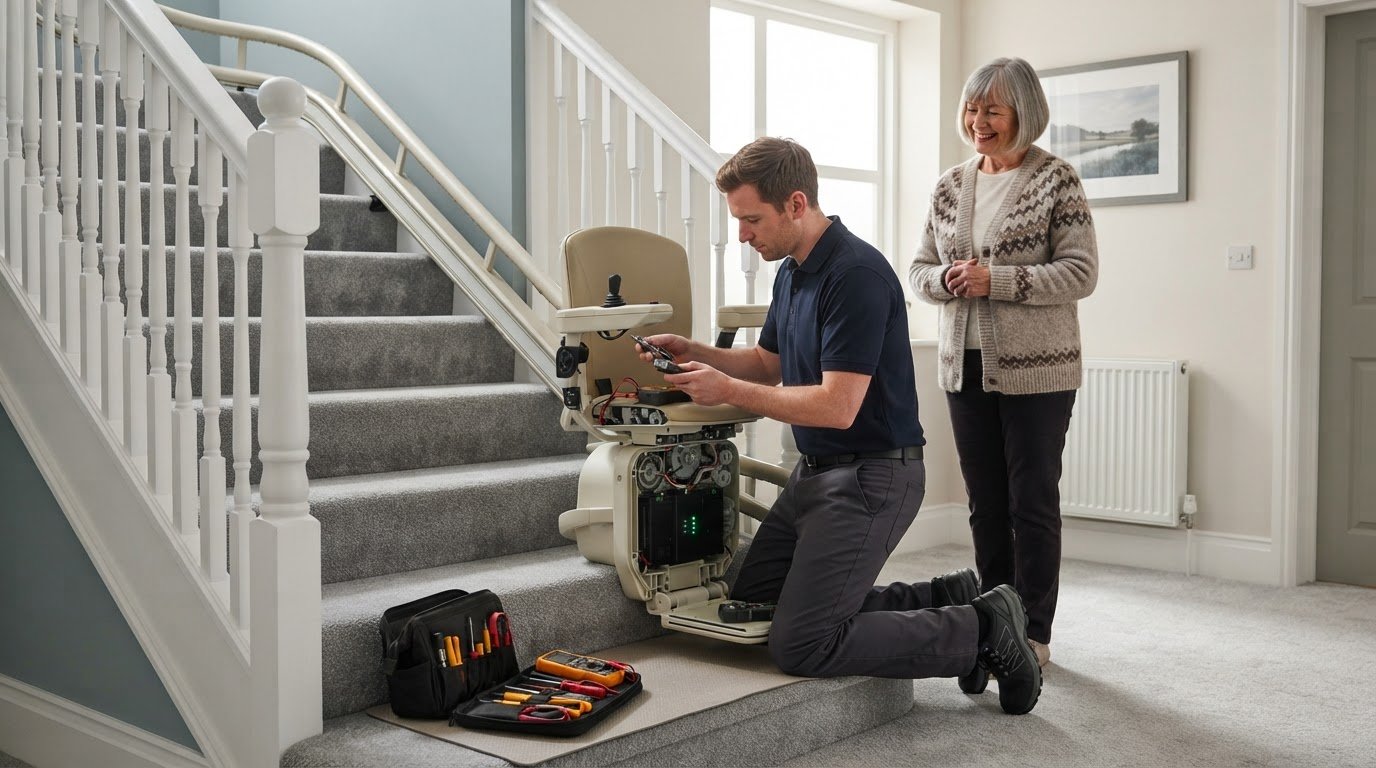
Professional installation is vital for preserving manufacturer warranties and verifying compliance with strict safety directives. A domestic lift carries you every single day, so certified engineers must secure every stanchion and calibrate every speed-governing brake precisely. Routine stairlift maintenance is non-negotiable when it comes to mechanical longevity. During a scheduled service, a technician loads-tests the internal batteries, inspects the rack-and-pinion drive for tooth wear, lubricates moving carriages, and confirms that all sensitive anti-entrapment edges cut power without hesitation. Having national breakdown service support means you are never left stranded if an unexpected fault occurs.
What to Expect on Installation Day
Having a lift fitted is surprisingly unobtrusive. For straightforward flights, experienced installers typically complete the entire fitting within two to four hours. The procedure follows an orderly routine:
Precision anchoring: Clamping brackets securely to the wooden steps without touching adjacent plasterwork.
Electrical commissioning: Running neat, concealed cabling to your nearest plug point to charge the internal power cells.
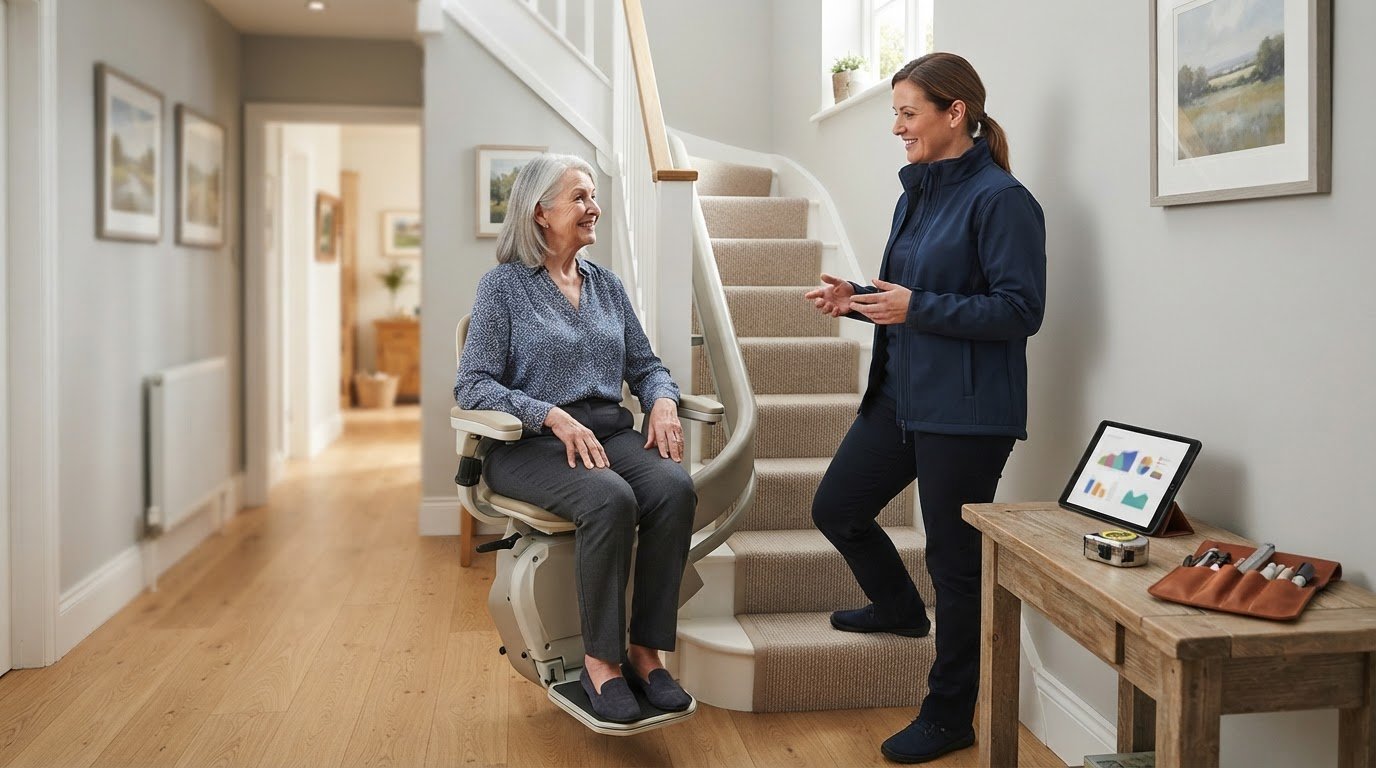
Personalised demonstration: Walking you through the controls step-by-step, ensuring you feel completely confident calling the carriage, fastening the seatbelt, and swivelling the seat safely onto the landing.
Spotless departure: Vacuuming away all minor wood shavings so your stairs look just as tidy as when the engineers arrived.
Support When You Need It Most
If your carriage suddenly refuses to travel, simple troubleshooting often resolves the issue before you need an on-site engineer. First, check that the main key switch has not turned off accidentally. Next, ensure the swivel seat clicked fully back into its locked driving position, and confirm that an errant shoe or object hasn't engaged the sensitive safety tray underneath the footplate. When mechanical wear or electronic faults do require hands-on care, professional stairlift repair restores older models quickly with approved replacement components. Investing in straight stairlifts is ultimately an investment in your autonomy, granting you comfortable, worry-free access to your entire home for decades ahead.
Taking the Confident Step Toward Everyday Independence
Regaining effortless access to your upstairs rooms doesn't require stressful disruption or major structural renovations. Modern straight stairlifts deliver a fast, dependable way to protect your physical safety whilst preserving the warmth and character of your home. Whether the robust Thyssen Homeglide matches your requirements or a customisable Stannah 260 installation suits your layout, finding the right solution simply comes down to honest guidance tailored to your lifestyle.
As specialist installers of Thyssen Homeglide and Stannah 260 equipment, we believe in providing calm, expert guidance with no high-pressure sales. From your initial spatial check right through to our national UK breakdown and maintenance support, we remain by your side to keep your equipment running smoothly for years to come.
Ready to reclaim total comfort across your living space? Get your free, no-obligation straight stairlift quote via WhatsApp today by sending a couple of simple photographs. You deserve to move through your favourite home with complete confidence and lasting peace of mind.
Frequently Asked Questions
How much space does a straight stairlift take up on the stairs?
When folded away, most straight stairlifts project roughly 380 mm to 400 mm from the wall, leaving plenty of clear corridor width. During transit with the footrest down, they typically occupy around 600 mm to 650 mm. This compact geometry ensures ambulant family members can safely walk up and down the staircase without feeling crowded or having their passage restricted.
Can a straight stairlift be fitted to any type of wall?
Stairlifts don't attach to your walls at all, so wall construction never restricts installation. The entire system is anchored directly into your wooden stair treads using small, rigid metal brackets. Whether your flanking wall is solid brick, dry-lined plasterboard, or timber studding, the structural integrity of your partition walls remains completely untouched throughout the fitting.
What happens to the stairlift if there is a power cut?
You won't get stuck midway if your mains electricity cuts out. Modern straight rail units run on dedicated 24V rechargeable batteries rather than relying directly on household current during transit. The mains supply merely keeps the internal cells charged while parked, meaning you will retain enough stored reserve to complete multiple full trips safely during an unexpected local blackout.
How quickly can a straight stairlift be installed in the UK?
A standard straight stairlift can typically be installed in just two to four hours once the engineer arrives. Because standard straight rails use pre-engineered aluminium extrusions cut to your staircase length, there is no multi-week delay for custom rail fabrication. Surveys, dispatch, and physical assembly can frequently happen within days of reviewing your staircase photographs.
Are straight stairlifts noisy to operate during the night?
Modern straight stairlifts operate with an exceptionally quiet hum, ensuring you won't disturb sleeping household members during late-night journeys. They rely on refined, low-voltage direct current motors coupled to precision-machined rack-and-pinion tracks. The smooth glide produces virtually no harsh vibration or jarring mechanical rattle, creating a whisper-quiet ride from the ground hallway all the way up to the landing.
Do I need to redecorate my hallway after the lift is installed?
No redecoration is necessary because the installation process leaves your skirting boards, paintwork, and wallpaper intact. Since installers secure the rail legs into the horizontal step treads through the carpet, the surrounding walls remain pristine. Professional engineers also clean up any wood shavings from drilling before leaving, ensuring your hallway looks just as neat and welcoming as before.
Is there a weight limit for standard straight stairlift models?
Most standard straight units safely accommodate passengers weighing up to 125 kg to 130 kg (around 19 to 20 stone). Heavy-duty straight designs, such as the Thyssen Homeglide, provide an increased capacity rating up to 160 kg (25 stone) on standard flight angles. Checking user weight prior to installation ensures the motor, seat, and safety gear remain matched to your individual physical needs.
Can I get a quote for a straight stairlift without a home visit?
Yes, you can receive an accurate, no-obligation quote without booking an in-person home visit. By capturing a couple of straightforward photos of your stairs on your smartphone and taking basic measurements, you can share them directly via WhatsApp or email. A technical specialist assesses the run, checks clearances, and provides clear, pressure-free advice directly to your phone.
Comments