Expert Stairlift Repair: Restoring Reliability and Independence at Home
Imagine waking up and realising your only way to the ground floor is stuck halfway up the rail. It isn't just a mechanical failure; it's a sudden, jarring loss of the independence you've worked hard to maintain. We understand how unsettling this situation feels. You might worry about being overcharged for simple parts, or perhaps you're anxious about waiting days for an engineer to arrive while you're trapped on one floor. It's natural to feel a sense of dread that a full, expensive replacement is the only solution left.
The good news is that expert stairlift repair often solves these issues quickly and affordably, restoring your mobility without the need for a brand-new installation. By choosing professional engineering and rapid breakdown support, you can get back to your routine with total peace of mind. In this article, we will explore how transparent pricing and clear communication can take the stress out of maintenance. You'll discover what typically goes wrong, how to prevent future faults, and why a specialist touch is the most reliable path to reclaiming your freedom at home.
Table of Contents
Common Stairlift Problems: Is Your Lift Broken or Just Baffled?
It's incredibly frustrating when your lift stops moving, especially when you're halfway between floors. Sometimes, however, it isn't a terminal breakdown but a minor misunderstanding between you and the machine. A modern stair lift is a sophisticated piece of kit designed with several safety interlocks. If just one of these isn't satisfied, the carriage won't budge. Understanding whether you need a professional stairlift repair or just a quick adjustment can save you a lot of worry and help you get moving again much faster.
Start by looking at your diagnostic display. Most lifts feature a small screen on the armrest or power pack that shows flashing numbers or letters. These codes are the lift's way of telling you exactly what's wrong. Similarly, if your lift is emitting a persistent beeping sound, it's often a signal about battery health. This usually happens when the lift isn't parked correctly on its charging point, or it might indicate the batteries are reaching the end of their typical three-year lifespan. Ignoring these signals can lead to a complete loss of power, so it's best to act as soon as you hear that first chirp.
Simple Troubleshooting You Can Do Today
Before you assume the worst, there are a few simple checks that often solve the problem without the need for tools. These quick steps can frequently restore your independence in seconds.
Check the key switch: Ensure the key is inserted and turned fully to the 'on' position. Sometimes it can be knocked slightly during cleaning.
Lock the swivel seat: Your lift won't move unless the seat is fully locked into the travel position. Give it a firm nudge to ensure it's clicked into place.
Inspect the track: Even a small object like a stray slipper or a build-up of pet hair can trigger the sensitive safety edges. Clear any obstructions you see along the rail.
Test the power supply: Ensure the wall socket is switched on and the transformer is plugged in securely. A loose plug is a common but easily fixed culprit.
When Troubleshooting Isn’t Enough
Sometimes, the issue is more than a simple oversight. If you hear unusual grinding, clicking, or whirring sounds, it could point to a worn drive pinion or a motor that's struggling under load. These aren't issues you should try to fix yourself. Attempting a DIY stairlift repair on high-voltage batteries or complex mechanical gearboxes is dangerous and could lead to further damage.
Safety sensors are there to protect you. If your lift stops mid-flight for no apparent reason, it might be a fault in the trailing cable or the sensors themselves. You should never try to bypass these safety features; doing so puts your safety at risk. Instead, booking professional stairlift servicing is the most reliable way to catch these small faults early. Specialist engineers have the diagnostic tools to identify PCB issues and mechanical wear accurately, ensuring your lift remains a safe and dependable part of your home.
The Diagnostic Process: How Professional Engineers Identify Faults
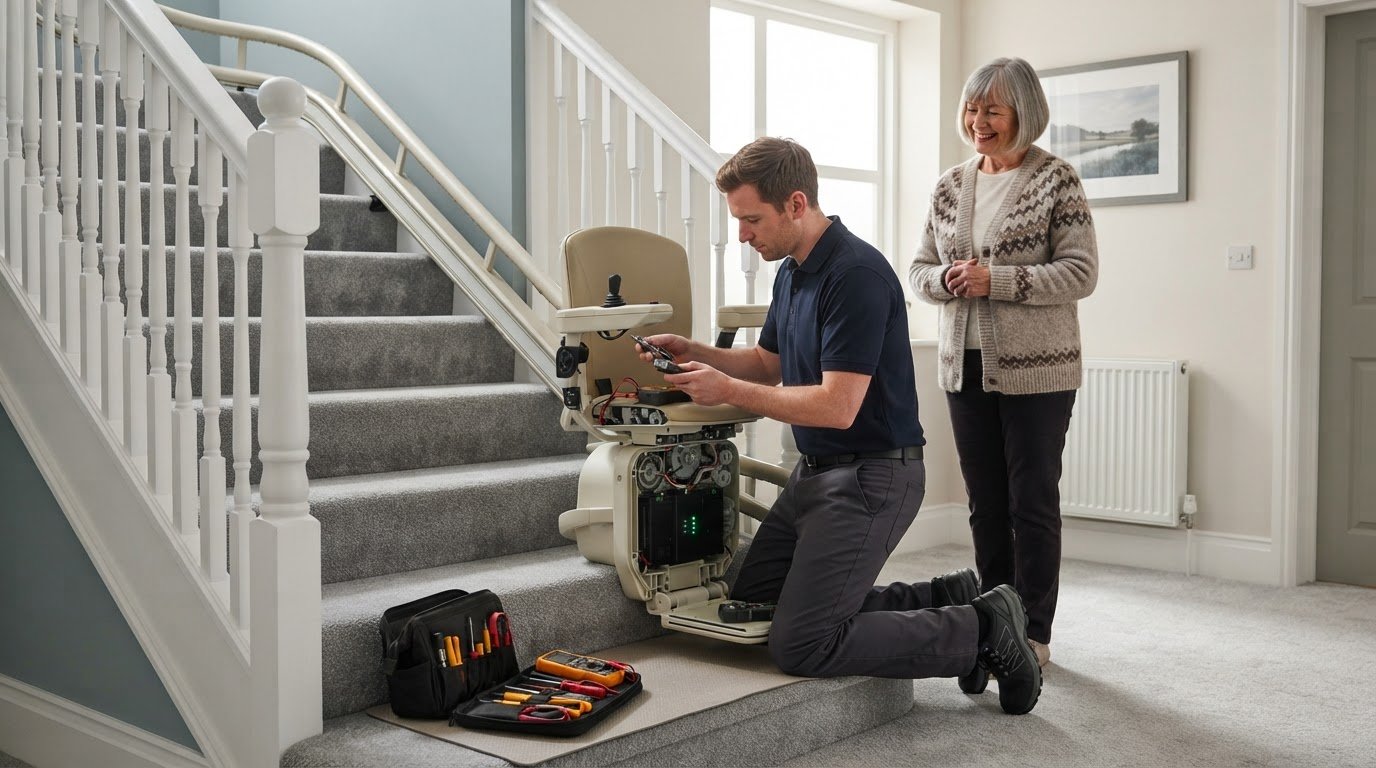
When an engineer arrives for a stairlift repair, they don't just look for the most obvious symptom. They follow a methodical path to ensure the entire system is safe and reliable. This structured approach is what separates a temporary fix from a long-term solution. Professional diagnostics involve looking deep into the machine's history and its current behaviour to prevent future breakdowns. As noted by consumer resources like Forbes Health, a professional assessment is vital for maintaining the value and safety of mobility equipment.
Modern systems, particularly specialised models like the Thyssen Homeglide or Stannah systems, require specific technical knowledge. An engineer who understands these brands knows exactly where to look for common wear patterns. This expertise allows them to work efficiently, saving you time and reducing the stress of a long wait. Throughout the process, we prioritise transparency. We'll show you exactly what has happened and explain the solution in plain English, ensuring you feel confident in the reliability of your lift.
Electrical and Electronic Health Checks
The first step often involves testing the battery voltage under load. A battery might seem healthy whilst the lift is stationary, but it can fail the moment it's tasked with a full ascent. We also examine the remote control receivers and the internal wiring looms. Intermittent connections are a common cause of "ghost" faults where a lift stops and starts without warning. The Printed Circuit Board (PCB) acts as the central brain of the lift, coordinating every safety signal and movement command with precision that requires specialist handling. If the PCB isn't communicating correctly with the sensors, the lift simply won't move.
Mechanical Integrity and Safety Checks
Mechanical inspections focus on the physical components that keep your journey smooth and secure. We check the integrity of the rail, the rollers, and the gearbox for any signs of excessive wear or misalignment. A critical part of this check is the overspeed governor, which is the safety component designed to prevent an uncontrolled descent. If you're worried about a specific sound or movement your lift is making, you can request an expert assessment to put your mind at rest.
Regular lubrication and cleaning are also essential. A simple service can often prevent a major repair by reducing friction on the drive pinion. Finally, we test every safety edge to ensure they meet current UK safety standards. These edges must be responsive to the slightest touch to protect you and your pets from trapped fingers or obstructions. By the time the diagnostic is complete, you'll have a clear picture of your lift's health and a straightforward plan to restore its performance.
Case Study: Restoring a Stannah 260 Curved Stairlift
A recent case involved a client whose Stannah 260 curved lift had begun stopping intermittently, usually right in the middle of a steep bend. This wasn't just a nuisance; it created a real sense of anxiety every time they used the stairs. Intermittent faults are often the hardest for non-specialists to find, but they are exactly what a professional stairlift repair is designed to resolve. When you're stuck between floors, you need more than a guess; you need a definitive answer.
Our engineer performed a series of tests on the carriage's movement whilst navigating the rail. They identified that the trailing cable, which provides power and data as the lift travels, had developed a hairline break. Additionally, the leveling motor sensor was sending conflicting signals to the brain of the lift. By pinpointing these specific electronic failures, we were able to avoid a costly and unnecessary full replacement of the entire unit.
Precision Work on Curved Rails
Curved stairlift repairs are inherently more complex than straight rail alternatives. Whilst a straight lift moves on a single plane, a model like the Stannah 260 must constantly adjust its seat level to keep the user upright as it navigates corners. This levelling technology is vital for both comfort and safety. Our engineers are specifically trained to handle the complex geometry of these twin-rail systems, ensuring the carriage remains perfectly balanced throughout the entire journey. We don't just fix the fault; we recalibrate the system to ensure the ride is as smooth as the day it was installed.
The Value of Genuine Spare Parts
For this repair, we prioritised sourcing manufacturer-approved components. Using universal or pattern parts might seem like a way to save money, but it often leads to compatibility issues or even safety risks. Historical safety data, such as this CPSC stairlift recall notice, reminds us that mechanical failures can have serious consequences if not handled with precision. By using genuine parts, we ensured the client's warranty remained intact and the lift met its original safety specifications.
The final outcome was a smooth, silent ride that restored the client's confidence. By performing a precision recalibration of the seat leveler alongside the part replacement, we effectively extended the life of the lift by several years. It's a perfect example of how targeted engineering can restore independence without the stress of a major home modification. If your lift is behaving unpredictably, a professional stairlift repair is often the most straightforward path back to normality.
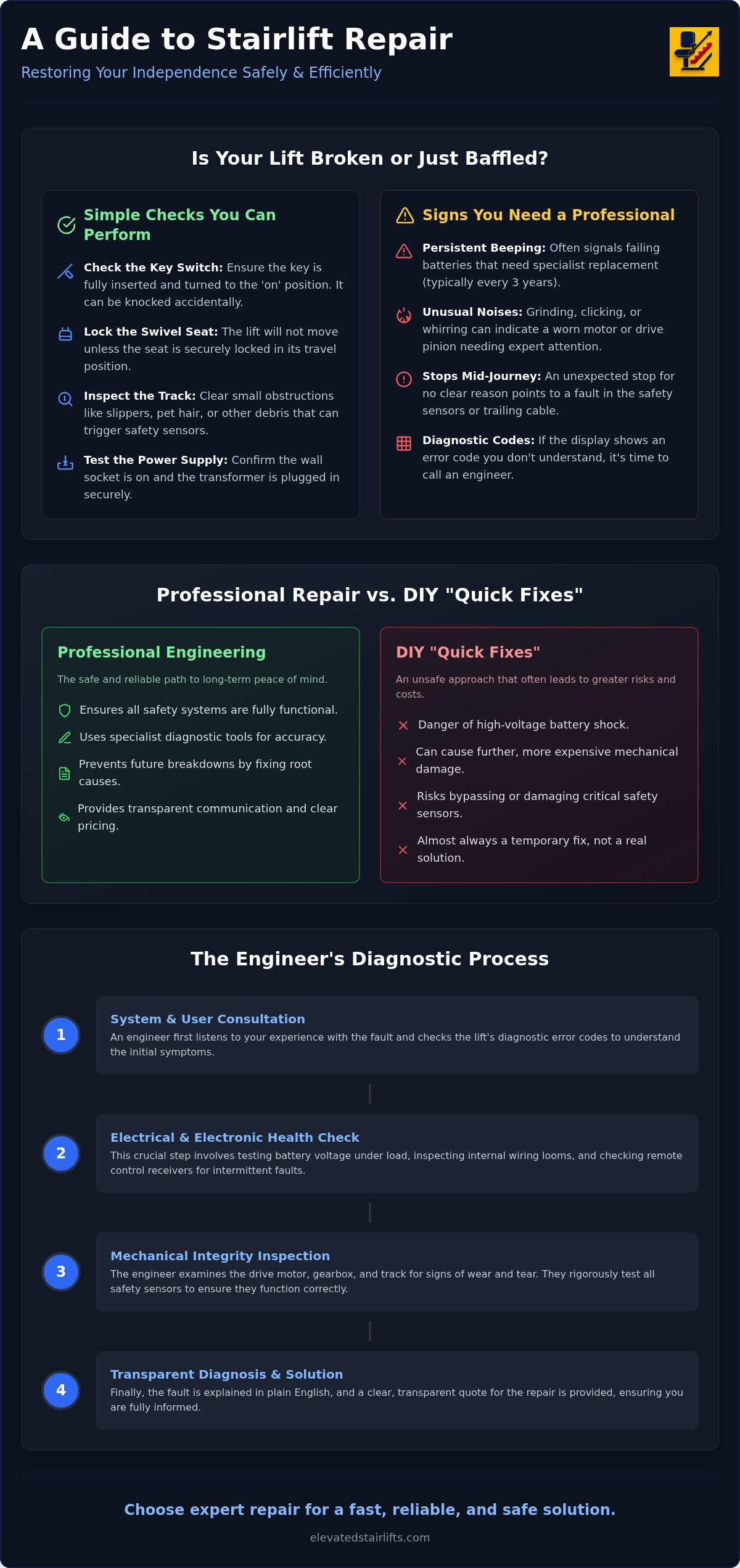
Why Professional Repair Outperforms DIY "Quick Fixes"
It is often tempting to try a quick fix when your lift falters, especially if you're handy with a toolkit. However, the internal workings of a modern lift are far more complex than they appear on the surface. Tinkering with high-voltage batteries or heavy mechanical components without specific training can be genuinely dangerous. A botched repair attempt often inadvertently disables critical safety features, such as the final limit switch. This component is designed to prevent the carriage from over-travelling, and if it's compromised, the risk of a serious accident increases significantly.
Choosing professional stairlift repair isn't just about safety; it's also a sound financial decision. Whilst a DIY attempt might seem like a way to save money, it often leads to further damage that is far more expensive to rectify. By ensuring your lift is maintained by experts, you protect the value of your home mobility investment and ensure it remains compliant with UK safety regulations, such as BS EN 81-40:2020. This standard covers the essential safety rules for the construction and installation of stairlifts, providing a benchmark for reliable performance.
The Risks of Unauthorised Repairs
Unauthorised repairs carry hidden dangers that can have long-term consequences. Incorrect wiring is a primary concern, as it can lead to a fire risk or permanent damage to the expensive Printed Circuit Board (PCB). If safety sensors are not correctly aligned after a repair, you could inadvertently create "trapping" points that pose a threat to users or pets. There's also the matter of insurance. Many providers may refuse to pay out on a claim if they discover the equipment hasn't been maintained by a qualified engineer. It's simply not worth the risk to your safety or your finances.
What to Look for in a Repair Service
When you're looking for support, prioritise a service that offers national UK coverage and a rapid response for breakdown situations. It's usually best to work with engineers who specialise in both stairlift installation and long-term maintenance. This depth of knowledge means they can identify potential issues before they become major faults. Look for a provider that offers transparent, upfront quoting so you know exactly where you stand. If your lift is currently out of action, you can request a professional breakdown service to restore your independence without the stress.
Booking Your Stairlift Repair: The Low-Friction Path to Reliability
When your mobility is at stake, the last thing you need is a complicated booking process or a long, ten-field form that leads to an unwanted sales call. We've simplified the entire journey to ensure your stairlift repair is handled with the speed and empathy you deserve. Our goal is to move you from a state of anxiety to a state of total reliability through a transparent, three-step process that prioritises your comfort and autonomy.
We understand that a broken lift feels like a significant barrier in your own home. That's why our approach is grounded in a supportive, non-pressured philosophy. You won't find any hidden fees or aggressive tactics here. Instead, you'll find expert guidance designed to help you make an informed decision at your own pace. By focusing on clear communication from the very first interaction, we aim to reduce the stress associated with home modifications and mechanical failures.
Step 1: Get Your Free WhatsApp Quote
The fastest way to understand what's wrong with your lift is to show us. Rather than waiting for an initial call-out, you can simply use WhatsApp to send us photos of your equipment. We recommend taking a clear picture of the chair, the rail, and specifically any error codes or flashing lights on the diagnostic display. These visual cues allow our specialist engineers to perform a remote assessment, often identifying the issue before they even leave the office.
This modern approach saves you time and provides an immediate sense of clarity. Once we've reviewed your photos, we'll send you a transparent estimate. This isn't a high-pressure quote; it's a factual assessment of what's needed to get you moving again. You can review this information in your own time, amongst your family, without any obligation to proceed until you're ready.
Step 2: Professional On-Site Diagnostic
If you decide to move forward, our engineer will visit your home at a time that suits you. We pride ourselves on national UK coverage, ensuring that expert help is available wherever you are. When our engineer arrives, they treat your space with the utmost respect. They'll perform a deep-dive diagnostic, checking the electrical and mechanical components we've discussed in previous sections, from the battery health to the integrity of the safety sensors.
Our "No Pressure" promise is central to this visit. The engineer will explain the fault in plain English and detail exactly how they plan to fix it. You remain in total control of the process. Whether it's a complex fix for a curved Stannah 260 or a straightforward adjustment for a Thyssen Homeglide, our focus is always on restoring your autonomy as quickly as possible. To help us prepare, it's useful if you can note down any unusual sounds or specific behaviours your lift exhibited before it stopped. This small bit of information helps us ensure we have the right manufacturer-approved parts on the van, making the stairlift repair as efficient as possible.
Reclaiming Your Freedom at Home
Navigating a mechanical breakdown doesn't have to be a source of stress or uncertainty. By choosing professional expertise over risky DIY fixes, you ensure your equipment receives the precise care it requires to remain safe and compliant. A targeted stairlift repair prioritises your safety through methodical diagnostics and manufacturer-approved parts, extending the life of your lift whilst avoiding the unnecessary expense of a full replacement. Whether you're managing a curved Stannah 260 or a Thyssen Homeglide, specialist knowledge ensures a smooth and reliable journey every time.
Our national UK breakdown support is built on a foundation of trust and empathy. We believe in providing a helpful, no-pressure service that puts your well-being first. If you're ready to restore your autonomy without the friction of complex forms, we're here to help. Get a free, no-obligation repair quote by WhatsApping us photos of your stairlift today. You deserve to feel secure and independent in your own home once again.
Frequently Asked Questions
How much does a typical stairlift repair cost in the UK?
The cost of a stairlift repair depends entirely on the nature of the fault and the specific parts required to fix it. Minor issues like battery replacements or sensor adjustments are typically more economical than replacing a motor or a control board. We believe in total transparency, which is why we offer free, no-obligation quotes through our WhatsApp photo service. This allows you to understand the investment required before an engineer even visits your home.
Can you repair an old stairlift if the manufacturer no longer supports it?
We can often repair older models even if the original manufacturer has reduced their support for that specific unit. Our engineers have extensive experience with a wide range of systems, including the Thyssen Homeglide and Stannah 260. We maintain a robust network for sourcing high-quality parts that meet safety standards. If a component is no longer available, we'll provide honest, professional guidance on the most reliable path forward for your mobility and safety.
How quickly can an engineer attend a stairlift breakdown?
We provide a dedicated national UK breakdown service designed to restore your independence as quickly as possible. We understand that being unable to access different floors of your home is an urgent matter, so we prioritise breakdown calls across the country. To speed up the process, we encourage you to send photos of any error codes via WhatsApp. This helps our engineers arrive prepared with the necessary tools and parts to complete the job efficiently.
Is it worth repairing a 10-year-old stairlift or should I replace it?
Many 10-year-old lifts are still structurally sound and can be restored to full reliability with a professional stairlift repair. If the rail is in good condition and the motor is functioning well, replacing a few electronic components or batteries is a very cost-effective alternative to a full replacement. We always provide a clear assessment of the lift's overall health, helping you decide if a repair offers the long-term value and safety you need for your home.
What are the most common fault codes for a Stannah 260?
The Stannah 260 uses a digital diagnostic display to communicate specific issues, such as a seat that isn't fully swivelled or a triggered safety edge. Codes might also indicate that the batteries aren't receiving a charge from the rail points. Whilst some of these are simple user fixes, others require a specialist engineer to recalibrate the sensors. If you're unsure what a code means, sending a quick photo to our team is the easiest way to get a helpful answer.
Do you provide a warranty on stairlift repair parts and labour?
Every repair we carry out comes with a comprehensive warranty covering both the replacement parts and the engineer's labour. We only use components that meet or exceed the original manufacturer's specifications to ensure your lift remains safe and dependable. This guarantee is part of our commitment to providing a supportive, high-quality service that prioritises your peace of mind. You can trust that the work we do is designed to last and protect your investment.
Can I still use my stairlift if it is making a strange noise?
If your lift begins making unusual grinding, squeaking, or clicking noises, you should stop using it and seek a professional inspection. These sounds are often early warning signs of mechanical wear in the gearbox or drive pinion that could lead to a sudden breakdown. Ignoring a new noise can result in more expensive damage later on. A quick service or minor adjustment now is often all that's needed to ensure your journey remains smooth, silent, and secure.
What should I do if my stairlift stops halfway up the stairs?
If the lift stops mid-travel, your first step should be to check that the swivel seat is locked and the key is turned on. Ensure there are no obstructions on the stairs triggering the safety sensors. If the lift still won't move, you should use the manual lowering arm if it's safe to do so, or wait for assistance. Once you're off the lift, contacting an expert for a diagnostic check will help identify the underlying electrical or mechanical fault.
Comments