How Much Electricity Does a Stairlift Use? UK Energy Guide 2026
Updated: Oct 2
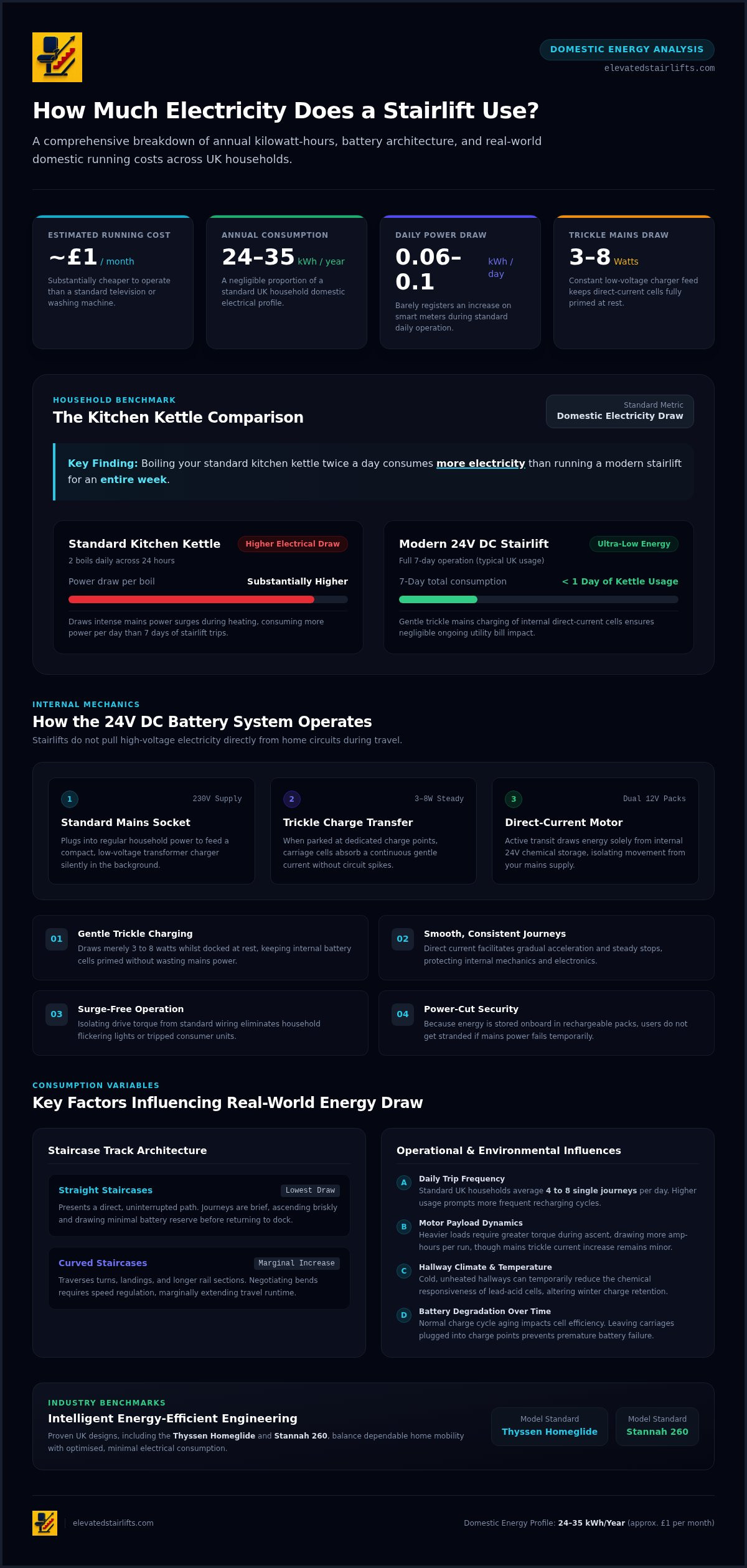
Boiling your kitchen kettle twice a day consumes more electricity than running a modern stairlift for an entire week. If you're worried that adding a lift might cause your household energy bills to spiral, you aren't alone. Given recent domestic tariff pressures across the UK, it's completely natural to wonder: how much electricity does a stairlift use?
We know how stressful rising utility costs can feel, particularly when you simply want a safe, dependable way to stay independent in the home you love. While the bulk of domestic energy spending typically goes towards central heating and hot water—where gas and heating specialists like Gas2Heat.com Ltd help homeowners optimise efficiency—mobility equipment demands far less power. The reassuring truth is that modern stairlifts rely on efficient rechargeable batteries, drawing only a gentle trickle of mains power to stay topped up. In reality, a typical unit costs roughly £1 a month to run; far less than a standard television or washing machine.
This guide breaks down the exact wattage and kilowatt-hour figures you can expect, dispels common charging myths, and explains how to keep your lift running at peak electrical efficiency all year round.
Table of Contents
How Much Electricity Does a Stairlift Use in a UK Home?
A frequent worry for UK homeowners considering home adaptations is utility impact. Many assume a mechanical lift moving up and down the stairs will draw heavy mains currents every time it glides into action. In truth, modern stairlifts consume an average of only 24 to 35 kilowatt-hours (kWh) per year, which equates to a negligible fraction of your overall domestic energy profile.
When you ask exactly how much electricity does a stairlift use, the answer lies in how power enters the machine. Stairlifts do not pull electricity directly from your home circuits during travel. Instead, they rely on self-contained, rechargeable direct-current batteries, meaning the impact on quarterly electricity statements is virtually undetectable.
The Direct Answer: Kilowatt-Hours and Daily Power Draw
A modern domestic stairlift typically consumes between 0.06 and 0.1 kWh daily. Active transit draws energy solely from internal twelve-volt battery packs wired together inside the carriage. Your standard 230V mains socket powers only a compact, low-voltage transformer charger, which operates silently in the background without causing circuit spikes.
How DC Battery Systems Optimise Electricity Consumption
Modern mobility lifts run on reliable 24V direct-current (DC) systems. Rather than pulling sudden surges of high-voltage power when you press the directional switch, the mechanics rely entirely on stored chemical energy. This setup delivers multiple clear benefits for UK households:
Gentle trickle charging: When parked at rest, the carriage draws a steady 3 to 8 watts from the mains, ensuring internal cells remain primed without wasting electricity.
Smooth, consistent journeys: Direct current ensures gradual acceleration and steady stops, protecting delicate electronic components while moving smoothly along the rail.
Surge-free operation: Isolating the motor from your household mains supply eliminates flickering lights or tripped consumer units.
Power-cut security: Because the system stores its own driving force, you won't get stranded between storeys if the local grid experiences a temporary outage.
Understanding this battery-driven architecture makes it clear how much electricity does a stairlift use on a day-to-day basis: barely enough to register on your smart meter, leaving your mind at ease.
Key Factors Influencing Your Stairlift Energy Consumption
While standard annual averages provide useful baselines, several day-to-day variables influence how much electricity does a stairlift use in practice. Everything from the physical shape of your staircase to motor workload plays a distinct role in determining energy draw.
According to advocacy research from the Centre for Ageing Better, adapting homes early helps individuals sustain independence comfortably. Understanding the practical mechanics behind your mobility equipment ensures you preserve that independence without facing unexpected utility spikes.
Straight versus Curved Staircase Track Requirements
Staircase layout forms the primary differentiator in energy consumption. Straight staircases present a direct, uninterrupted path. Journeys are brief; the carriage ascends briskly, drawing minimal battery reserve before returning to its charging dock.
Curved installations, by comparison, traverse turns, landings, and longer rail sections. Negotiating bends requires the motor to regulate travel speeds, marginally extending runtime. These intricate track designs need accurate alignment to prevent mechanical drag, as outlined in our comprehensive guide to professional stairlift installation.
Daily Usage Frequency and User Weight Dynamics
How often you travel between storeys naturally shapes battery recharge demand. Consider these operational influences:
Daily frequency: A typical UK household completes four to eight single journeys each day. Doubling that frequency doubles the depletion rate, prompting the transformer to recharge cells more often.
Motor payload: Higher payloads require greater torque during ascent. Heavier loads draw more amp-hours from the battery per run, though the increase in mains trickle current remains minor.
Hallway climate: Cold, unheated hallways can reduce the chemical responsiveness of internal lead-acid cells, temporarily reducing charge retention in winter.
Battery Degradation and Charging Efficiency Over Time
Stairlift batteries gradually degrade through normal charge cycles. As cells age past their prime, internal electrical resistance rises. The charger must work harder and draw mains current for longer periods to reach full capacity. Worn batteries hold less charge, leading to sluggish ascent and frequent charging beeps.
Recognising these early warning signs helps you schedule timely cell replacements before mechanical components face unnecessary strain. You can review detailed replacement signals in our complete stairlift maintenance overview.
If you're ever uncertain about your current setup or want reassurance regarding operational efficiency, exploring support options with ElevatedStairlifts can help ensure your system functions smoothly and economically across every journey.
Stairlift Energy Usage versus Common Household Appliances
Putting kilowatt-hour ratings into perspective becomes much simpler when you compare them to items you switch on every day. Many homeowners picture a stairlift as an industrial piece of heavy machinery, assuming its electricity draw resembles an electric oven or an immersion heater. Looking at real household wattage figures reveals that stairlifts rank amongst the gentlest power consumers in British homes.
To understand how much electricity does a stairlift use in context, compare typical domestic appliances against the trickle-charging mechanism of a modern lift carriage:
Appliance Power Consumption: Wattage and Running Comparison
Consider how standard household devices stack up in terms of operational wattage and average monthly running demands:
Domestic electric kettle: Consumes 2,200W to 3,000W while boiling. Boiling water several times across the day typically costs £4 to £10 each month.
Standard microwave oven: Operates at 800W to 1,200W, drawing considerable instantaneous power whenever reheating meals.
LED television (43-inch): Uses roughly 50W to 80W in use, plus passive standby current, accumulating £4 to £8 in running costs per month.
Modern stairlift charger: Consumes between 10W and 20W during active battery recovery, and just 3W to 8W on idle standby, translating to roughly £1 a month.
In fact, a standard kitchen kettle uses twenty to thirty times more electrical energy during a single three-minute boil than your stairlift charger pulls over hours of gentle maintenance. For property owners and organisations seeking broader ways to keep rising utility overheads under control, you can learn more about Easy2switch UK Ltd and how strategic supplier comparisons help secure better energy rates.
Active Transit Power versus Continuous Standby Charging
The distinction between travel and stationary resting explains why these costs remain so low. During travel, the carriage motor draws between 200W and 400W of battery power. None of that energy pulls directly from your walls, protecting your consumer unit from abrupt current spikes. Mains electricity steps in solely after the journey completes, feeding a tiny current to replenish what was spent.
Standby mode requires only a few watts to power remote sensors, diagnostic indicator lights, and internal safety cutoff circuits. If you want to evaluate how various carriage systems and track designs fit into different domestic settings, explore our complete overview of modern stairlift solutions for UK homes.
Seeing these comparative figures side by side should give you total peace of mind. When questioning how much electricity does a stairlift use, remember that keeping your lift fully operational costs significantly less than watching the evening news on television.
How to Maximise Stairlift Energy Efficiency and Battery Health
Keeping ongoing running expenses low requires looking after the mechanical and electrical health of your lift. While learning how much electricity does a stairlift use brings immediate relief, adopting good everyday habits protects the system from unnecessary wear. Simple daily practices ensure internal components operate at maximum electrical efficiency year after year.
Preserving battery life comes down to avoiding false economies and maintaining clear contact points along the track.
Why You Must Never Turn Off the Mains Socket
Switching off the wall socket before bed might feel like a sensible way to trim power bills, but it actually causes severe harm. When isolated from mains power, internal safety monitoring circuits and diagnostic sensors draw their operating current entirely from the backup batteries. Left uncharged overnight, the batteries can undergo deep discharge.
Allowing sealed lead-acid cells to flatten completely triggers irreversible chemical deterioration. A habit meant to save fractions of a penny on mains current inevitably causes premature battery breakdown, landing you with avoidable replacement bills. Always leave the dedicated wall socket switched on.
Ensuring Proper Alignment on Rail Charging Contacts
Most rail designs feature distinct metal charging nodes at the top and bottom landings, while others use continuous conductive strips. Correct parking ensures these connection points touch firmly:
Listen for diagnostic beeps: If your carriage stops short of a terminal dock, it will emit a continuous or intermittent acoustic chime warning you that charging has paused.
Reposition promptly: Use the joystick or directional switch to ease the unit fully into its dock until the chime silences.
Keep contacts clean: Dust and pet hair can form a thin insulating barrier over metal charging plates, impeding power transfer and causing the transformer to run inefficiently.
The Role of Routine Maintenance in Reducing Power Drain
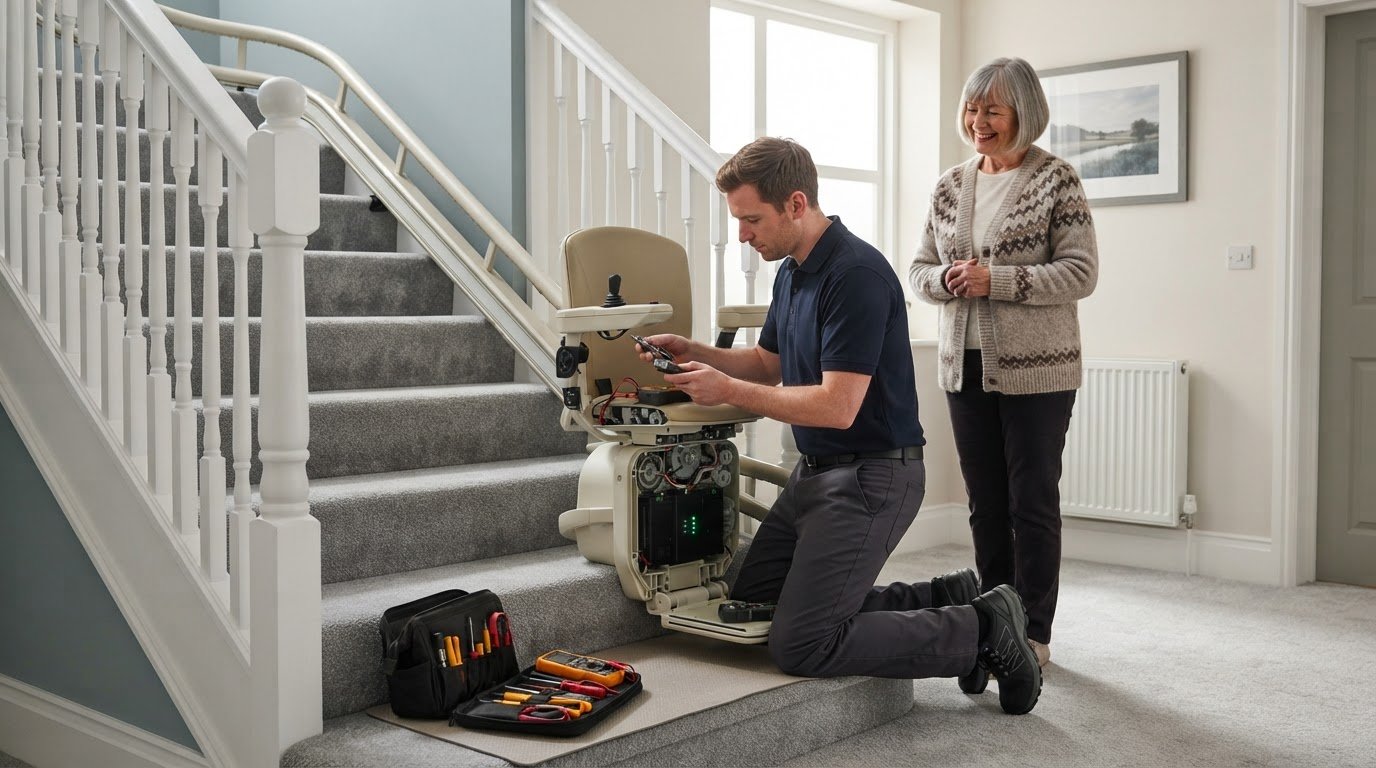
Friction directly dictates motor workload. If a rail gathers grit, or the drive rack lacks proper lubrication, the motor must pull significantly higher current from the batteries to haul the carriage upwards. Over time, worn guide rollers and gear teeth force the electrical system to work harder on every single journey.
Routine maintenance keeps mechanical resistance to a minimum, ensuring your motor consumes only standard wattage. When stubborn mechanical resistance or electrical faults arise, our guide to reliable stairlift repair covers essential troubleshooting advice.
If you notice unusual noises or sluggish travel that might be impacting your unit's power draw, arrange a professional stairlift service with our certified engineering team to restore smooth running and preserve battery health.
Choosing an Energy-Efficient Stairlift for Long-Term Peace of Mind
Selecting the right mobility lift involves balancing comfort, safety, and operational reliability. Knowing how much electricity does a stairlift use gives homeowners genuine reassurance, but choosing a well-engineered unit ensures those electrical running costs stay negligible over many years of daily service.
Modern manufacturing standards prioritise high energy efficiency alongside smooth mechanical performance, combining low-power standby modes with intelligent transformers.
Modern Engineering in Leading Straight and Curved Models
Contemporary stairlift architecture uses smart power management systems that shift into low-wattage sleep modes when parked. These standby circuits consume only tiny sips of power to keep safety interlocks active and remotes ready to respond.
For straight stairways, the Thyssen Homeglide exemplifies this refined engineering. Its robust DC drivetrain delivers dependable journeys while maintaining an ultra-light electrical footprint on home circuits. If your staircase features turns, half-landings, or fan steps, curved solutions require equal precision. The Stannah 260 installation offers custom twin-rail adaptability alongside highly efficient battery management, ensuring complex ascents consume minimal power. To understand broader budgeting elements alongside energy usage, consult our comprehensive stairlift price guide UK.
Transparent Advice and Simple Photo Quotes with ElevatedStairlifts
Adapting your home should feel empowering rather than daunting. ElevatedStairlifts takes an empathetic, supportive approach that avoids high-pressure sales visits, focusing instead on clear guidance tailored to your specific mobility needs.
Getting accurate recommendations is straightforward and entirely free from hassle. Simply take a few clear photographs of your staircase from the top and bottom, then send them over via WhatsApp or email. Our technical team assesses your stairs directly, providing transparent recommendations without home disruption.
Specialist model installation: Expert fitting for proven straight and curved systems, including the Thyssen Homeglide and Stannah 260.
Nationwide maintenance support: Dedicated stairlift service options to keep mechanical tracks aligned and prevent power loss.
Rapid breakdown service: Skilled stairlift repair across the UK to resolve unexpected electrical or mechanical faults swiftly.
Protecting your mobility shouldn't mean worrying about how much electricity does a stairlift use each quarter. Receive your free, no-obligation stairlift quote from ElevatedStairlifts and take the next step towards effortless, worry-free independence at home.
Protecting Your Independence Without High Utility Bills
Staying comfortable and confident in your own home shouldn't come with the fear of runaway energy bills. When evaluating how much electricity does a stairlift use, the facts offer complete peace of mind. Consuming just 24 to 35 kWh per year, modern battery-driven units cost around £1 a month to operate. Keeping your carriage plugged in at dedicated charge points protects internal cells, ensuring you avoid premature battery degradation while enjoying smooth, dependable transit.
ElevatedStairlifts delivers trusted nationwide stairlift installation for leading systems, including the Thyssen Homeglide and Stannah 260. Backed by dedicated breakdown service options and routine servicing support, our team keeps your mobility equipment running quietly and efficiently year after year.
You don't need to endure pushy salespeople to find the right answer for your home. Simply take a couple of staircase snapshots from the top and bottom of your flight and send them to us via WhatsApp or email. Get your free, no-obligation stairlift quote by sharing your staircase photos today, and look forward to effortless, worry-free living.
Frequently Asked Questions
How much electricity does a stairlift use per day?
A standard domestic stairlift consumes between 0.06 and 0.1 kilowatt-hours (kWh) of electricity daily under normal household usage. This equates to roughly 24 to 35 kWh across an entire year. Because internal batteries power active travel and the wall charger provides only a gentle trickle charge, your daily running cost amounts to mere pence, ensuring you won't notice any meaningful change on quarterly utility statements.
Can I leave my stairlift plugged in all the time?
Yes, you must leave your stairlift plugged in and switched on continuously at the mains socket. Modern battery systems rely on this steady low-voltage connection to preserve optimal cell health. Turning the wall switch off overnight forces safety circuits to drain the internal batteries flat. Deep discharging causes irreversible chemical deterioration, leading to preventable battery failure and early replacement expenses rather than household energy savings.
What happens to my stairlift during a power cut?
Your stairlift will continue working normally during a power cut. Because modern units operate from onboard rechargeable direct-current batteries rather than directly from mains electricity, you won't get stranded between storeys if the local grid goes down. Fully charged batteries typically deliver between eight and ten complete return journeys without mains supply, allowing you to move safely between floors until power returns.
Does a curved stairlift use more electricity than a straight one?
Yes, curved stairlifts consume slightly more electricity than straight models, though the financial difference remains negligible. Curved rails cover longer distances and navigate bends that require the motor to adjust travel speeds, extending journey times. Even with this extra mechanical demand, reviewing how much electricity does a stairlift use demonstrates that curved installations cost only a few pounds extra across a full twelve months of operation.
Will a stairlift cause a surge that trips my consumer unit?
No, a stairlift cannot trip your consumer unit through operational power surges. The drive motor pulls current exclusively from internal 24V batteries, completely isolating travel draw from your household mains circuits. The wall socket connects solely to a compact transformer charger drawing between 10W and 20W whilst topping up the cells. This modest current draw is comparable to charging a tablet, posing no strain to domestic trip switches.
How much power does a stairlift consume on standby?
When parked and fully charged, a modern stairlift consumes between 3 and 8 watts on standby. This modest trickle maintains full battery capacity whilst powering basic background components like remote receivers, digital displays, and internal safety sensors. By comparison, many televisions and set-top boxes consume 10 to 15 watts in sleep mode, making your stairlift one of the gentlest standby appliances in your home.
Why is my stairlift beeping when it is parked?
An audible beep usually indicates that your carriage has stopped slightly outside its designated charging position. When parked even a centimetre away from the metal contact pins, the batteries stop receiving current, triggering an acoustic alert before the cells drain. Simply use the directional control to ease the chair fully onto its terminal dock until the beeping silences and charging resumes smoothly.
Comments