Slimline Stairlifts: Your 2026 Space-Saving Guide for UK Homes
Over 4.5 million older UK terraced homes feature staircases narrower than 750mm, making the choice of slimline stairlifts essential for maintaining a safe, walkable home. If you live in one of these properties, you likely worry that a mobility aid will block the way for family members or look like a bulky eyesore. It's a common concern, and it's completely understandable to feel hesitant about changing the character of your home.
We believe you shouldn't have to choose between your safety and your space. Modern compact designs are engineered to be incredibly discreet, featuring folding mechanisms that preserve precious walking room for everyone else. By selecting the right model, you can restore your independence whilst maintaining the flow and comfort of your household.
This 2026 guide explores the most space-saving solutions available, including the latest Thyssen Homeglide and Stannah 260 systems. We will explain the updated BS EN 81-40:2020 safety standards and show you how to get a professional quote using just a few photos. Our goal is to provide the clear, honest information you need to make your home accessible again with total peace of mind.
Table of Contents
What is a Slimline Stairlift and Why is it Essential for Narrow UK Stairs?
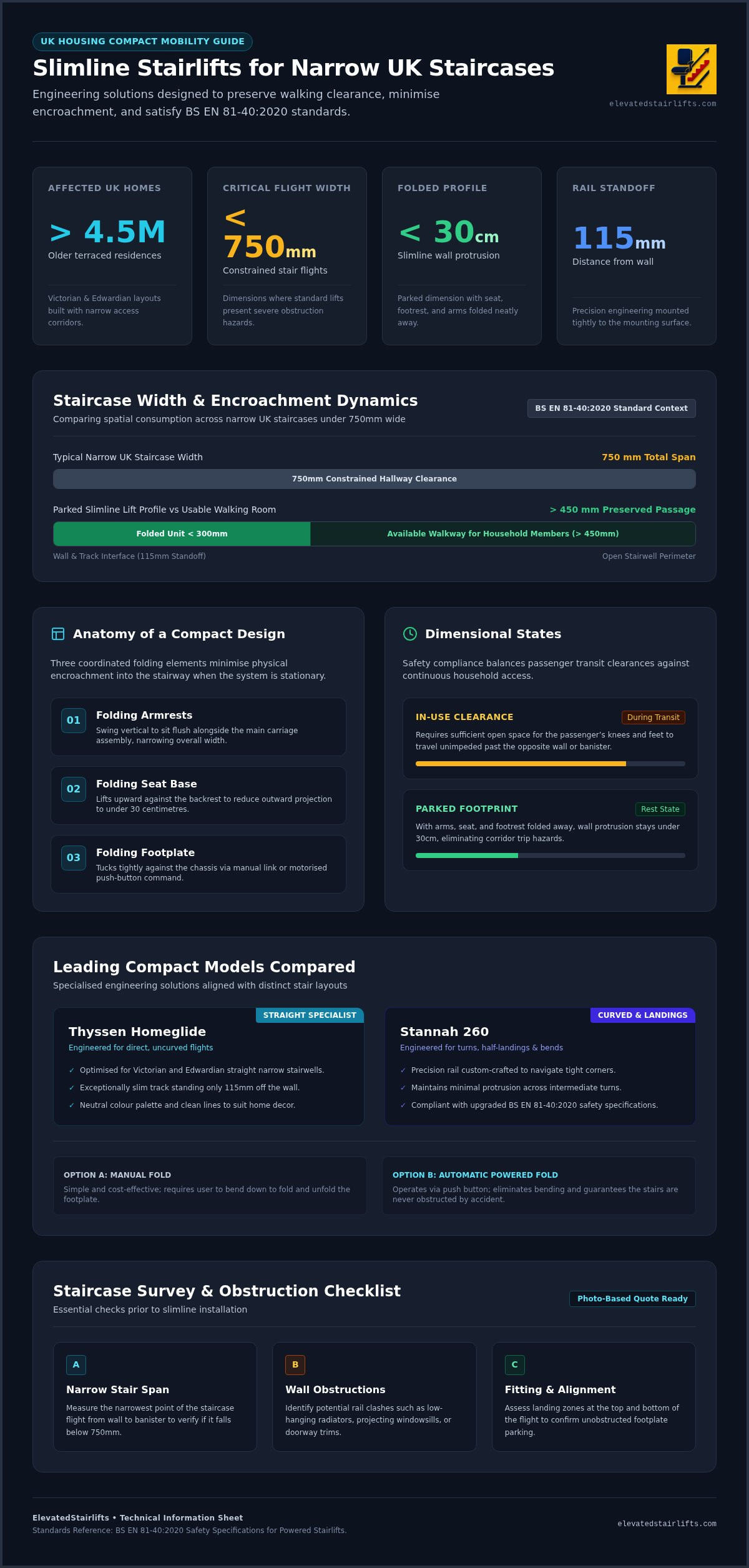
A slimline stairlift is a compact mobility solution designed specifically for environments where every millimetre of space matters. Unlike standard models that can dominate a hallway, these units use specialised engineering to minimise their physical footprint. In the UK, this isn't just a luxury; it's often a necessity due to our unique architectural heritage. Many Victorian and Edwardian terraced homes feature staircases that are significantly narrower than modern building standards. Research indicates that over 4.5 million older UK homes have flights under 750mm wide. On a staircase this narrow, a traditional lift could easily become a trip hazard or prevent other household members from using the stairs safely.
The primary goal of slimline stairlifts is to reduce "encroachment," which is the distance the unit sticks out from the wall. By keeping this measurement as small as possible, the stairs remain walkable for everyone else in the house. It's helpful to distinguish between "in-use" and "parked" dimensions. The in-use measurement is the space required whilst you are actually travelling. The parked dimension is the footprint when the lift is at rest with its components tucked away. A well-designed slimline unit ensures that even when the lift is in transit, there is sufficient clearance for knees and feet to clear the opposite wall or banister.
The Anatomy of a Compact Design
The secret to these space-saving wonders lies in three main areas: folding arms, seats, and footrests. When you aren't using the lift, these components tuck away neatly against the carriage to clear the path. Modern rail technology also plays a huge role. Tracks are now designed to sit as close to the mounting surface as possible, often standing only 115mm from the wall. Generally, slimline stairlifts are defined as units that protrude less than 30cm from the wall when fully folded. This tiny footprint is what allows them to fit into homes where a standard installation would simply be impossible.
Preserving the Character of Your Home
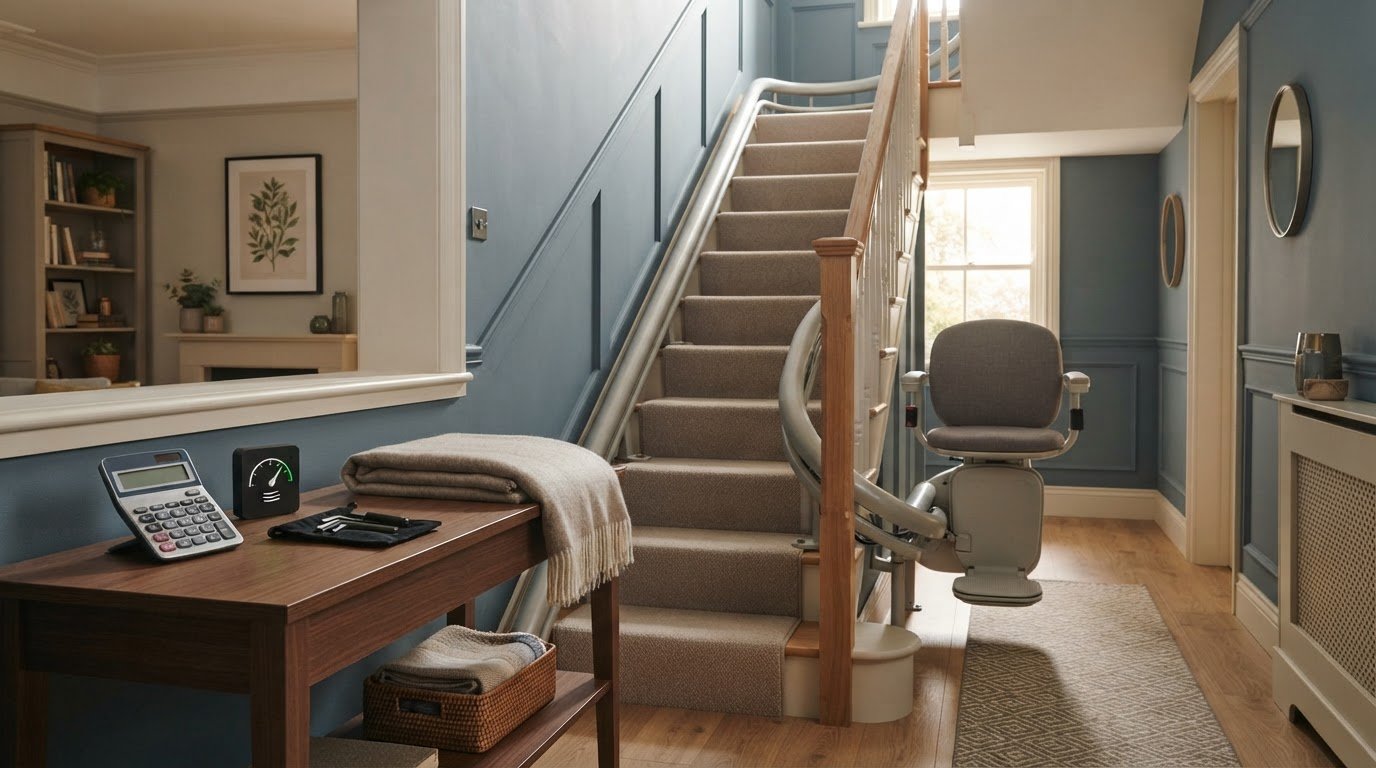
We understand that your home is your sanctuary, and you don't want it to feel like a clinical environment. Modern slimline models have moved away from the bulky designs of the past. They now feature sleek lines and neutral colour palettes that blend into your existing decor. By choosing discreet rail placements and colour-matched upholstery, you can maintain the aesthetic appeal of your hallway whilst gaining the mobility you need. For a broader look at how these systems fit into your lifestyle, you might find our Essential Stairlift Solutions: 2026 Guide for UK Homes helpful. Choosing a slimline model is about more than just measurements; it's about finding a balance between independence and the comfort of your home environment.
Comparing Compact Models: Thyssen Homeglide and Stannah 260
Selecting the right mobility aid depends entirely on the layout of your home. Not all slimline stairlifts are designed for the same task, and understanding the differences between leading models is the first step toward a safer home. For straight flights, the Thyssen Homeglide is often the premier choice due to its exceptionally slim profile. If your staircase includes a bend or a landing, the Stannah 260 offers the precision engineering required to navigate those tight turns. Many families find that NHS guidance on home adaptations provides a helpful starting point for assessing how these installations can prevent falls whilst keeping the stairs clear for others.
One of the most important decisions you'll make involves the folding mechanism. You can choose between manual and automatic powered options. A manual mechanism is simple and cost-effective, but it requires the user to bend down to tuck the footrest away. Automatic options are a brilliant alternative for those who find bending difficult. With a powered fold, the lift neatly collapses at the touch of a button, ensuring the hallway is never obstructed by accident. It's a small detail that makes a massive difference in daily life.
Thyssen Homeglide: The Straight Staircase Specialist
The Homeglide has earned a stellar reputation for reliability, particularly in narrow British terraced houses. It features a folded profile depth of just 385mm, which is roughly 15 inches from the wall. This makes it one of the most discreet straight lifts available. Its single aluminium rail is designed to sit close to the skirting board, preserving as much walking room as possible. If you're looking for a dependable, space-saving solution, our Expert Thyssen Homeglide Installers can help you determine if this model fits your specific requirements.
Stannah 260: Precision for Curved Narrow Stairs
Curved staircases require a more bespoke approach. The Stannah 260 uses a twin-rail system that can be tailored to follow the exact contour of your stairs, even around the tightest winder turns. Whilst it has a slightly larger folded footprint of 405mm compared to straight models, it offers incredible customisation for narrow landings. It can even be designed to "park" around a corner, leaving the main staircase completely unobstructed. Professional fitting is essential here to ensure the twin-rail track is perfectly aligned for a smooth, quiet journey.
Choosing a model with a proven UK service history is vital for long-term peace of mind. Both the Thyssen and Stannah ranges are well-supported across the country, meaning parts are easy to source if you ever need a repair. It's about ensuring your independence is maintained without any unnecessary stress. If you're ready to see how these models look in a real home, you can explore our specialist installation options to find the best fit for your space.
Folding Dimensions and Rail Design: Maximising Space Whilst Ensuring Safety
When we talk about the folded width of slimline stairlifts, we're referring to the total distance the unit protrudes from the wall when it's at rest. For a staircase to remain safe for other residents, this measurement is critical. Most compact models, like the Thyssen Homeglide, fold down to just 385mm. This leaves ample room for others to walk past without feeling squeezed against the banister. If you're concerned about the cost of these specialised modifications, you may be eligible for a Disabled Facilities Grant to help cover the installation of essential safety equipment.
The rail itself is the backbone of the system. Modern tracks are designed to sit incredibly close to the wall, usually standing only 115mm away. This tight fit is achieved through extruded aluminium or twin-tube steel designs that hug the skirting board. Despite being so compact, these units don't compromise on safety. They include multiple sensitive obstacle detection sensors around the footplate and carriage. If a pet or a stray object is on the stairs, the lift stops instantly. These sensors are a mandatory requirement under BS EN 81-40:2020 standards, ensuring that a slim design never sacrifices passenger protection.
Another vital feature for narrow homes is the swivel seat. On a tight landing, there isn't always room to step off the chair sideways. An offset swivel allows the seat to turn toward the landing, acting as a barrier behind you as you stand up. This ensures you dismount safely onto level ground rather than near the edge of the top step. It's a simple mechanical solution that provides immense peace of mind.
Understanding Safety Clearances
Knee clearance is often the deciding factor in narrow homes. It's the distance from your spine to your kneecaps whilst seated. If your staircase is exceptionally tight, we measure this precisely to ensure your knees won't clash with the opposite wall or a low bulkhead. UK safety standards recommend a minimum passage width for other users to ensure the stairs remain a safe route for the whole household. We always prioritise this balance between your mobility and the safety of your family.
Powered vs Manual Folding
Automatic folding footrests are a popular choice because they remove the need for you to bend down at the top or bottom of the stairs. With the touch of a button, the footrest tucks away neatly. This is especially useful if there's a doorway at the foot of the stairs. In these cases, a powered hinge rail can be fitted. The track literally lifts out of the way when the lift isn't in use, clearing the trip hazard and allowing the door to open fully. It makes the entire process effortless and keeps your hallway feeling open and tidy.
How to Measure Your Staircase for a Slimline Installation
Taking the first steps toward home modification can feel daunting, particularly when you're worried about whether your staircase is too narrow. Measuring your stairs is a straightforward process that provides the clarity you need to move forward. To begin, you'll need a metal tape measure to find the "clear walking width." This is the distance between the two narrowest points on your flight. Don't just measure wall-to-wall; you must account for the furthest protrusions, such as a handrail, a stringer, or a bulky radiator. Getting this right ensures that your slimline stairlifts will have enough room to operate without clashing with the opposite side.
You also need to calculate the "nose-to-nose" length of the stairs. This is the diagonal measurement from the edge of the very bottom step to the edge of the top landing. This figure helps us determine the exact length of the rail required. Finally, look at the "parking" space at the top and bottom. Is there enough room for the chair to sit at rest without blocking a doorway or creating a trip hazard in the hallway? Modern compact rails are designed to minimise this footprint, but identifying these areas early helps in choosing the right model for your home.
The Narrow Stairs Checklist
Before you commit to a specific model, it's helpful to run through a quick site survey of your own. These small details can significantly impact which lift is right for you:
Identify the narrowest point: Check the entire length of the flight, as Victorian homes often taper near the top.
Check for bulkheads: Stand on the middle step and ensure there is enough headroom. Standard safety requires about 2,000mm of clearance from the step nose to the ceiling.
Spot obstructions: Look for windowsills, radiators, or low-hanging pictures that might interfere with the carriage as it passes.
Doorway clearance: Note if a door opens directly onto the stairs at the bottom, as this may require a powered hinge rail.
The WhatsApp Solution: Expert Eyes Without the Home Visit
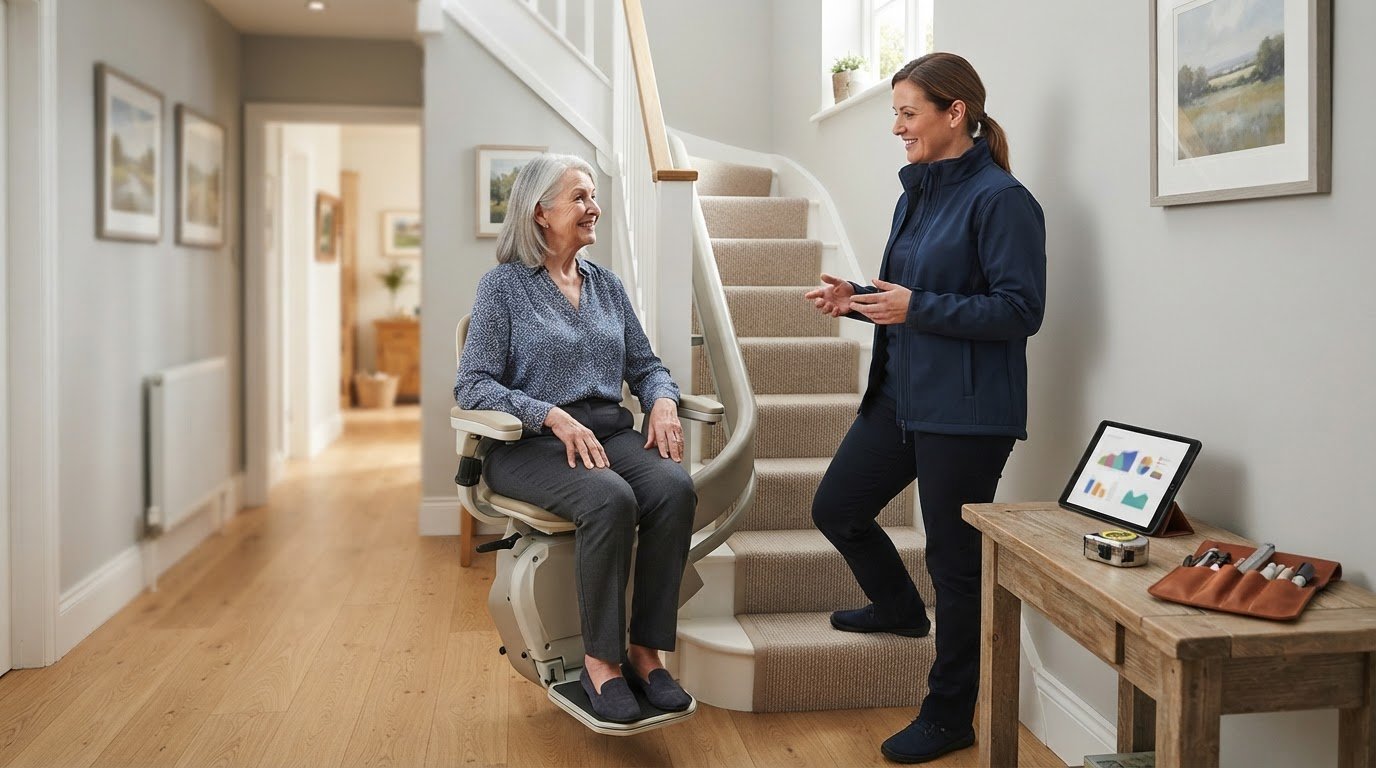
We know that many people feel hesitant about booking a formal home visit before they've even decided on a model. To make things easier, we offer a no-obligation quote service via WhatsApp. By sending us a few simple photos, our specialists can provide an initial assessment of your staircase's suitability for slimline stairlifts. This low-pressure approach allows you to get expert advice from the comfort of your armchair. For more detailed information on how these systems work in practice, you can read our 2026 UK Guide: Slimline Stairlifts for Narrow Stairs.
When taking your photos, try to capture three main angles: a clear view from the bottom looking up, a view from the top looking down, and a side profile of the entire flight. These images allow us to spot potential challenges, like tight winder turns or radiator obstructions, that might not be obvious from measurements alone. If you're ready to see what's possible for your home, you can send us your staircase photos today for a professional, friendly review of your space.
Expert Slimline Installation: Restoring Independence with ElevatedStairlifts
Once you've selected the right model and measured your staircase, the focus shifts to the installation itself. Professional fitting is the only way to ensure your track is perfectly aligned with the unique contours of your home. This is especially true for slimline stairlifts, where the margin for error is incredibly small. A rail that is even slightly out of position could lead to unnecessary wear or, in the worst cases, prevent the carriage from clearing a narrow turn. Our team takes the time to ensure every bracket is secured precisely, giving you a smooth, quiet ride from day one.
We prioritise a gentle, supportive approach during every home visit. Our specialists are there to guide you, not to pressure you. We understand that modifying your home is a significant decision, and we want you to feel completely comfortable with every step of the process. From the initial photo assessment to the final safety demonstration, our focus remains on restoring your autonomy with care and precision.
Professional Fitting and Safety Testing
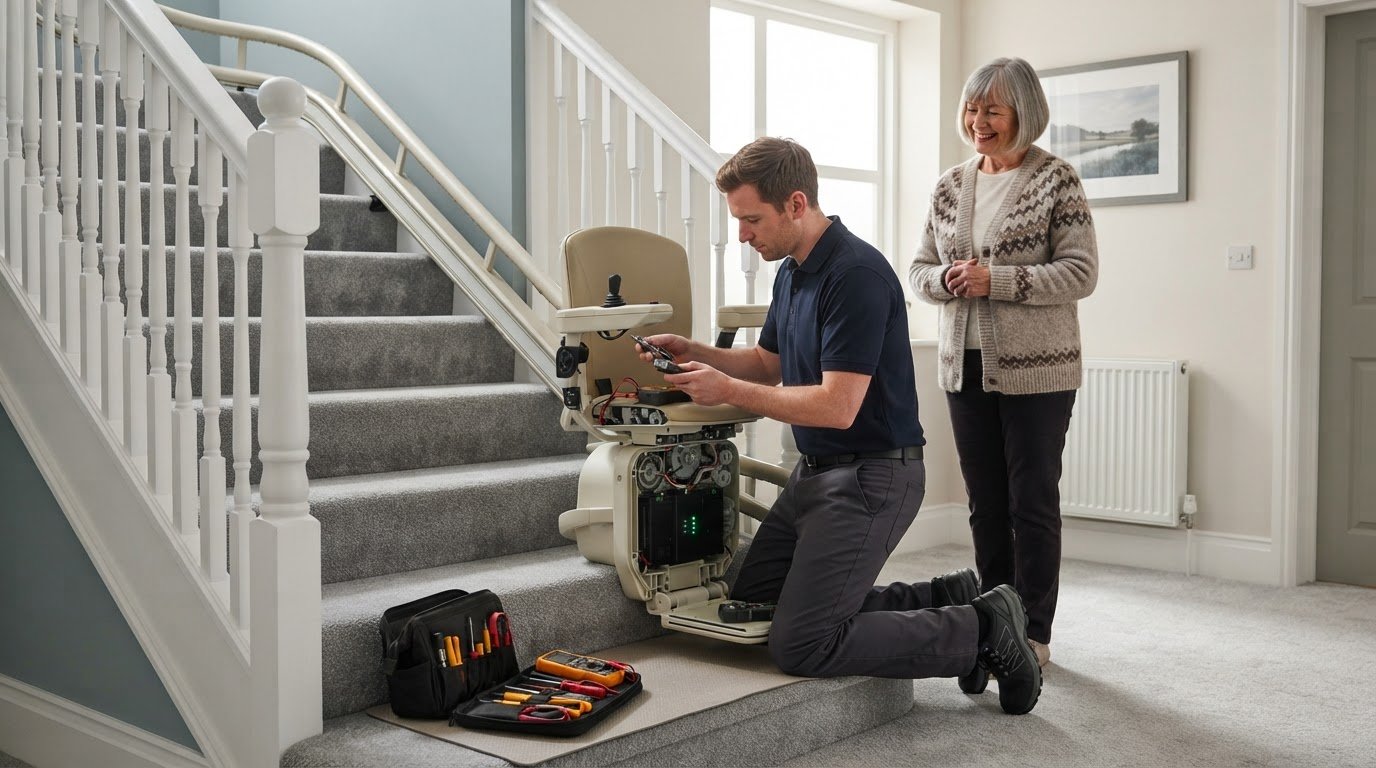
Attempting a DIY installation is never recommended for these specialised units. Beyond the physical difficulty of the task, modern lifts are complex pieces of machinery that require expert calibration to meet UK safety standards. Every installation we perform concludes with a rigorous series of safety checks. We test the obstacle detection sensors, the emergency stop functions, and the battery backup systems to ensure everything is in perfect working order. For a deeper look at what happens on the day, you can explore The Complete Guide to Professional Stairlift Installation. Most fittings are completed in half a day, and we pride ourselves on leaving your home exactly as we found it, with minimal mess and no structural changes required.
Reliable Repair and Breakdown Support
Your independence shouldn't be interrupted by technical hitches. We believe that a mobility solution is only as good as the support that comes with it. That's why we provide comprehensive maintenance and breakdown services for the models we install, including the Stannah 260 and Thyssen Homeglide. Regular servicing keeps the mechanical parts moving freely and ensures the batteries remain at peak performance. If you ever encounter an issue, having a local expert who understands your specific slimline system makes all the difference. If you're ready to reclaim your staircase, Request your free, no-obligation slimline stairlift quote today.
Reclaim Your Independence and Your Space Today
Reclaiming your independence shouldn't mean sacrificing the comfort and flow of your home. By choosing slimline stairlifts, you're opting for a solution that prioritises both your safety and the needs of other household members. We've explored how compact models like the Thyssen Homeglide and Stannah 260 use clever folding technology to maintain clear walkways on even the narrowest UK staircases.
Finding the right fit doesn't have to be a stressful or clinical process. Our expert installers provide national UK support and comprehensive repair services to ensure your lift remains reliable for years to come. If you're unsure about dimensions, our no-pressure photo-based quote service is a simple way to get professional advice without a home visit.
Ready to see how a discreet mobility solution can transform your daily life? Get a Free Slimline Stairlift Quote via WhatsApp and take the first step toward a more accessible home. We're here to help you move freely again with total confidence and peace of mind.
Frequently Asked Questions
What is the narrowest staircase that can accommodate a slimline stairlift?
Slimline models can typically be accommodated on staircases with a clear width as narrow as 650mm to 680mm. Whilst standard building regulations for new builds suggest 850mm, these specialised units are designed specifically for the tight constraints of older UK terraced homes. It's essential to measure the narrowest point, including any handrails or radiators, to ensure the carriage can pass safely without obstructing the user's knees or feet during travel.
Can a slimline stairlift be fitted to a curved staircase?
Yes, specialised models like the Stannah 260 are designed specifically for curved flights with tight bends. These systems use a custom twin-rail track that follows the exact contour of your staircase, even on narrow winder turns. Whilst straight slimline stairlifts are more common, curved versions provide the same space-saving benefits by allowing the chair to park neatly around corners, keeping the main stairway clear for other residents.
Do slimline stairlifts have a lower weight capacity than standard models?
Not necessarily, as many compact models offer robust weight capacities comparable to larger units. For instance, the Thyssen Homeglide supports up to 145kg (22.8 stone) as standard, with an "Extra" package increasing this to 160kg. Similarly, the Stannah 260 can be fitted with a heavy-duty option to accommodate users up to 160kg. Engineering advancements ensure that a smaller footprint doesn't mean a sacrifice in structural strength or passenger safety.
Will a slimline stairlift rail block a doorway at the bottom of the stairs?
A rail doesn't have to block your hallway or doorway if you opt for a folding hinge section. This clever addition allows the bottom part of the track to lift up and out of the way when the lift isn't in use. You can choose between manual hinges or automatic powered versions that raise the rail as the chair ascends. This ensures your home remains a safe environment without any permanent trip hazards.
How much does a slimline stairlift cost compared to a standard model?
The cost of a slimline model is generally similar to standard versions, though prices vary based on the complexity of your staircase. For a straight flight, you might expect a range between £1,500 and £3,500, whilst curved bespoke systems typically start from £4,000. Factors like powered folding footrests or hinge rails can influence the final investment. We recommend checking if you qualify for 0% VAT on slimline stairlifts under HMRC rules.
Can I get a reconditioned slimline stairlift for a narrow staircase?
Reconditioned models are often available and provide a cost-effective way to access high-quality engineering. These units undergo rigorous testing and safety checks to ensure they meet the same BS EN 81-40:2020 standards as brand-new installations. Whilst a reconditioned straight lift might cost between £1,000 and £1,800, availability depends on current stock levels. It's a reliable option for those seeking a professional mobility solution on a more modest budget.
Is it possible to get a quote for a slimline stairlift without a home visit?
Yes, you can receive an accurate initial assessment and quote without booking an in-person appointment. By sending photos of your staircase via WhatsApp, our experts can evaluate the width, pitch, and any potential obstructions like radiators. This no-obligation service is designed to be low-pressure and transparent, allowing you to explore your options from home. If the photos indicate a good fit, we can then discuss the next steps for your installation.
What happens to a slimline stairlift during a power cut?
Your lift will continue to function normally during a power cut because it runs on a dedicated 24V DC battery circuit. These batteries are constantly trickle-charged when the unit is parked at its charging points. In the event of a blackout, most models have enough stored energy to complete between 20 and 30 journeys. This ensures you are never stranded on one floor and can continue to move safely until power is restored.
Comments