Stairlift for Falls Prevention: Safer Stairs for Seniors
Updated: Oct 2
Could a stairlift help reduce the risk of a fall on the stairs without being the whole answer? If you’re worried that a stumble could affect someone’s confidence or independence, it’s understandable to want a practical plan. A stairlift for fall prevention may reduce the need to climb the stairs, but it won’t remove every risk or suit every person and staircase.
This guide looks at practical changes around the stairs, what a stairlift can and can’t do, and how to decide what support to explore. If balance, strength, pain or confidence is affecting stair use, a GP or other clinician may help identify appropriate support. An occupational therapist can consider how the person manages daily activities at home, while a stairlift professional can assess the person and staircase together. Start with the immediate concerns, then take the next step that feels right.
Table of Contents
Stairlift for fall prevention: what it can and cannot do
Worry about the stairs can affect how someone uses their whole home. They may avoid certain rooms, change daily routines or feel less confident doing things independently. It’s natural to look for a way to make the stairs more manageable, but fall prevention means reducing avoidable risks, not guaranteeing that a fall cannot happen.
A stairlift carries a seated user between floors, reducing the need to climb. For someone who finds climbing tiring, painful or difficult, it may remove one challenging part of getting around at home. If you’re exploring a stairlift for fall prevention, be clear about its role: A stairlift supports access between floors; it isn’t a whole-home fall-prevention plan. For a basic explanation of how these devices work, see Stair lift.
When might a stairlift be worth considering?
Start by noticing how the stairs affect everyday life. Is climbing becoming tiring, painful or difficult? Does the person avoid going upstairs, need to pause or rely heavily on another person? These observations can help define the problem, but they don’t establish whether a stairlift is suitable.
Consider whether the person can get on and off a seat safely, follow the steps involved and manage their usual routine at the top and bottom of the stairs. If their health, balance or ability to transfer is uncertain, ask a GP or another clinician for guidance. An occupational therapist can consider daily activities; a stairlift professional can assess the staircase and equipment options. These are different forms of advice, and one doesn’t replace the other.
What a stairlift does not address
A stairlift only addresses travel on the staircase. It won’t remove hazards on a landing, in a bathroom or elsewhere in the home, and it can’t guarantee that someone will remain independent or avoid injury. The person still needs to get on and off the seat and move safely at either end.
Suitability depends on the individual, their mobility and ability to transfer, the staircase and the space around it. Photographs may help a professional understand the layout, but can’t confirm suitability on their own. If safe use is in doubt, seek appropriate clinical or occupational therapy advice as well as an individual assessment before deciding.
How to make stairs safer for seniors: start with a simple home review
A calm visual check can help identify practical issues to address. This is an observation checklist, not a clinical assessment. Don’t ask someone to test their balance or use the stairs if they feel unsafe. Start by checking lighting, clutter and handrail condition. Arrange help for anything that needs lifting, repair or working at height.
Check the staircase and landing
Look up the staircase from the bottom, then check the top landing. Are the steps and landings easy to see, including in the evening? Look for loose coverings, damaged areas, objects on the stairs and anything narrowing the walking space. Move small items only if it’s safe, and don’t carry a heavy load on the stairs. Arrange suitable repairs for problems you can’t safely resolve; for external entrance steps where sunken or cracked masonry creates a severe trip hazard, resources like airliftconcreteexperts.com demonstrate how targeted step repairs can help restore level, stable footing.
Check whether the handrail feels secure and is comfortable for the person to use. If it’s loose, damaged or poorly placed, ask someone qualified to assess it rather than attempting an uncertain repair. If you’re unsure what changes are appropriate, ask a relevant health professional for guidance based on the person’s needs.
Review how the stairs are used
Think about an ordinary trip upstairs. Is the person wearing footwear that feels secure? Do they carry laundry, shopping or other items that block their view or occupy a hand? Do they hurry because of a phone, doorbell or another distraction? These details can point to routines worth changing.
Where it feels safe, allow time to move at a steady pace and use the handrail. Avoid carrying bulky or heavy loads on the stairs; consider whether someone can help or whether items can be moved separately. Don’t prescribe a new way of walking or using the rail if balance, strength or pain is a concern. A health professional or occupational therapist can discuss movement strategies suited to the individual.
Lighting: Can the person see the steps clearly from top to bottom?
Walking space: Are stairs and landings clear of loose items and obstructions?
Step visibility: Are the edges easy to distinguish?
Handrail: Does it feel secure and usable?
Routine: Are rushing, unsuitable footwear or carrying items making stair use harder?
These observations can help clarify what to address before considering a stairlift for fall prevention. If climbing remains difficult, you can also explore professional stairlift installation as one equipment option, alongside advice suited to the person’s needs.
Stairlift or other changes: choose support that matches the fall risk
The right support depends on what makes movement difficult. A stairlift may reduce the need to climb between floors, while clearing an obstruction addresses a different issue. If balance, vision or strength is a concern, equipment or household changes alone may not be enough. A stairlift isn’t automatically suitable for every person or home, so consider individual needs alongside the staircase and any clinical advice.
When a stairlift may fit the situation
A professional assessment should consider the staircase layout, the person’s mobility and everyday routine, and whether they can get on and off the seat safely. Age or a diagnosis alone can’t determine suitability, and a short online description won’t establish which equipment is appropriate. For wider context on home mobility, see the independent living stairlift guide.
When other help may be needed as well
Repeated difficulty, a change in balance or concerns about vision or strength are reasons to discuss the situation with a GP or another suitable health professional. If medication may be relevant, ask a clinician or pharmacist for advice; don’t stop or change prescribed medicine without guidance. An occupational therapist may also help consider how the person manages everyday activities at home.
If a fall has caused a serious injury, or someone is in immediate danger, seek urgent medical help. Call 999 in an emergency. The aim is to match each response to the need, rather than expecting a stairlift for fall prevention to address every risk on its own.
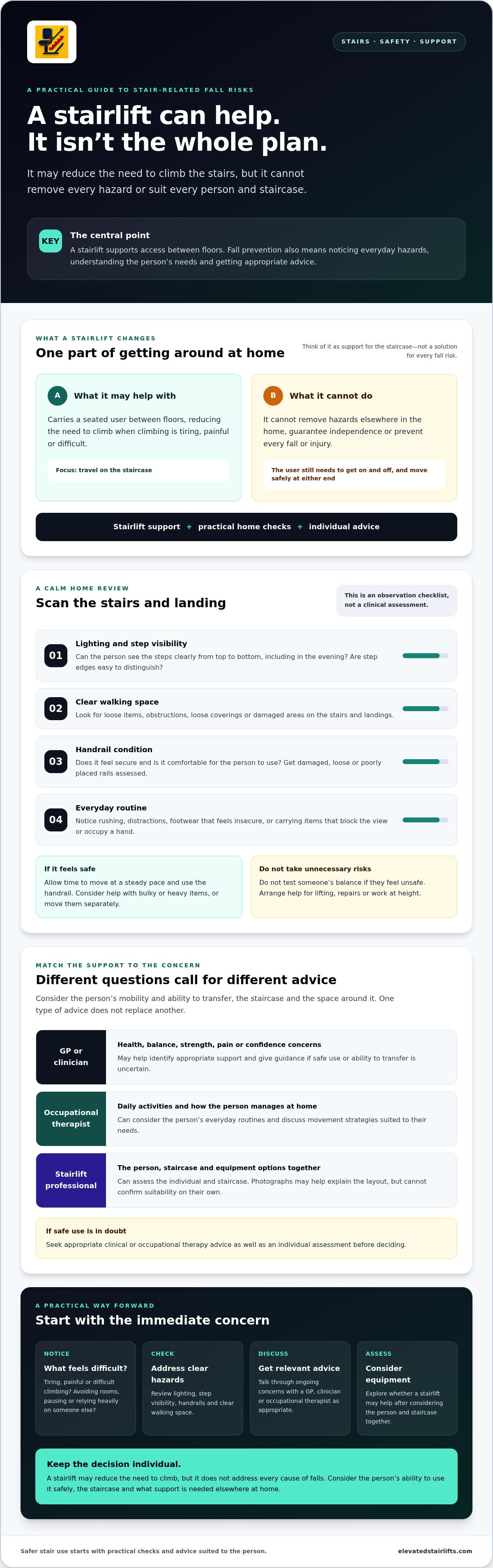
A practical next-step plan for reducing stair-related fall risks
Work through concerns in a steady order rather than trying to change everything at once. Start with what you can safely observe at home, discuss recurring difficulties with an appropriate health professional, then consider whether equipment or other changes may be suitable.
Address obvious hazards. Clear small items from the stairs and landings if it’s safe. Note problems such as poor visibility, loose coverings or an unstable handrail. Don’t attempt repairs or carry heavy objects on the stairs if that could put anyone at risk.
Record what’s happening. Note recent falls or near misses, when stair use feels difficult, and any changes in mobility. These details can make a conversation with a GP or clinician more specific.
Seek relevant advice. Ask about recurring falls, dizziness or changing mobility. An occupational therapist may help assess daily activities and home needs, including stairs and safe transfers.
Explore equipment if appropriate. If climbing remains difficult, discuss whether a stairlift might suit the person and staircase. An individual assessment is important; a brief description or photograph alone can’t confirm suitability.
Household observations can identify concerns, but they aren’t a clinical assessment. Discuss staircase or equipment changes with a qualified professional, and health concerns with an appropriate clinician. The professional stairlift installation guide may be useful when you’re ready to explore fitting.
Decide who to involve and what to ask
Before speaking with a GP or other clinician, prepare questions about whether a health concern could be affecting stair use and who can advise on safe movement. An occupational therapist may consider daily activities and whether other adaptations should be explored. For an equipment assessment, ask how the staircase will be reviewed and what the person needs to do to get on and off safely.
Keep safety equipment dependable
If a stairlift is installed, use it as instructed and pay attention to unusual changes in its operation. Don’t attempt repairs based on guesswork; contact a suitable service professional if it needs attention. For general guidance on looking after a stairlift, read the stairlift maintenance guide.
Considering a stairlift for fall prevention? Once health concerns and immediate hazards have been considered, you can discuss stairlift installation options with ElevatedStairlifts. The team provides professional installation, servicing and breakdown support; suitability still depends on an individual assessment.
Considering a stairlift for fall prevention? Get individual advice before deciding
If stairs are becoming difficult, take time to understand what’s causing the difficulty, review the staircase and seek advice suited to the person’s needs. A stairlift may reduce the need to climb, but it isn’t a complete fall-prevention solution and won’t be right for every person or home. Consider health or mobility concerns separately from whether the equipment can be fitted and used safely.
ElevatedStairlifts provides professional stairlift installation, servicing and breakdown support. The company installs models including the Thyssen Homeglide and Stannah 260; ask about current availability and whether an option may suit the person and staircase. For a broader overview, read the stairlift solutions for UK homes guide.
What to prepare before asking about a stairlift
Before making an enquiry, note who would use the stairlift, the everyday journeys they need to make and any concerns about sitting down, standing up or transferring at either end. If health, balance or safe transfers are uncertain, discuss them with an appropriate health professional. This helps distinguish equipment questions from clinical ones.
Clear staircase photographs can support an initial enquiry. Show the stairs and landings if you can do so from a safe position. Photographs may help with an initial quote, but they don’t replace any assessment needed to confirm suitability. The person and staircase both need to be considered before a decision is made.
What to expect from a supportive enquiry
It’s reasonable to ask how suitability is considered, what installation involves, and what servicing and breakdown support is available. An enquiry can help you gather information and understand possible next steps; it doesn’t commit you to a purchase. Take the time you need to compare that information with any clinical or occupational therapy advice.
If you’re considering a stairlift for fall prevention, ElevatedStairlifts offers a free, no-obligation quote. Send staircase photographs by WhatsApp or email to begin an enquiry, bearing in mind that photographs alone can’t confirm suitability. It’s a practical way to start gathering information, while the decision remains yours.
Take the next step towards safer, more confident stair use
Safer stairs start with noticing what makes them difficult and addressing practical hazards where it’s safe to do so. If concerns continue, discuss changes in mobility or repeated falls with an appropriate health professional. A stairlift for fall prevention may reduce the need to climb stairs, but it isn’t a guarantee against falls or a substitute for wider support.
If a stairlift may suit the person and home, an individual assessment can help clarify the next steps. ElevatedStairlifts provides professional installation, servicing and breakdown support across the UK. You can request a free, no-obligation quote by sending staircase photographs via WhatsApp or email. Photographs can support an initial enquiry, but don’t confirm suitability on their own.
When you’re ready to explore the option, request a free, no-obligation stairlift quote and take the next step at a pace that feels right.
Frequently Asked Questions
Can a stairlift prevent falls on the stairs?
No stairlift can guarantee that falls won’t happen. It may reduce the need to climb, which could help if climbing is difficult, but it doesn’t remove risks elsewhere in the home or during transfers on and off the seat. A stairlift for fall prevention is one possible part of a wider, person-centred plan, not a complete solution.
Is a stairlift suitable for someone who has already fallen?
Possibly, but a previous fall doesn’t automatically mean a stairlift is suitable. Consider what happened, whether the person has pain or changing mobility, and whether they can get on and off a stairlift safely. Discuss health concerns or repeated falls with a GP or other appropriate clinician. An occupational therapist can consider daily activities, while a stairlift professional can assess the person’s needs alongside the staircase.
What can I do to make stairs safer for an older person?
Start with a safe visual check. Make sure the steps and landings are well lit, keep walking space clear, and look for loose coverings or damaged areas. Check whether stair edges are easy to see and whether the handrail feels secure. Avoid rushing or carrying bulky items on the stairs. Arrange suitable repairs for hazards you can’t safely address yourself, and seek professional advice about individual movement concerns.
Should an older person use the stairs after a fall?
Don’t encourage someone to climb the stairs if they may be injured, feel faint or unsteady, or are in pain. If there’s a serious injury or immediate danger, call 999. If it isn’t an emergency but you’re unsure what to do, contact NHS 111 or a health professional for advice. Once immediate concerns have been addressed, discuss recurring falls or difficulty using stairs with a clinician.
Can a stairlift be fitted to any staircase?
No. Suitability depends on the staircase layout and available space, as well as the person who would use the equipment. An assessment should consider whether the user can get on and off safely and how the stairlift would work with the home’s layout. Staircase photographs can help with an initial enquiry, but can’t confirm suitability on their own. Ask a professional to assess the specific staircase.
Who can assess fall risks at home in the UK?
A GP or other appropriate clinician can discuss health concerns, repeated falls or changes in mobility. An occupational therapist may help assess how someone manages daily activities and what support may suit their needs at home. A stairlift professional can assess the equipment and staircase, but this isn’t a clinical assessment. The right person to contact depends on whether the concern is health, everyday activity or stairlift suitability.
Does a stairlift remove the need to make other home-safety changes?
No. A stairlift addresses travel up and down the staircase, but it won’t clear hazards on the stairs or landings, or address risks in other rooms. Keep considering practical safety needs throughout the home and discuss health or mobility concerns with an appropriate professional. Choose equipment to match the person and their circumstances, rather than treating it as a replacement for other relevant advice or changes.
Comments