Stairlift for Wooden Stairs: How to Choose in 2026
Updated: Oct 2
Could a wooden staircase be suitable for a stairlift? Timber treads aren’t automatically a barrier, but that doesn’t mean every staircase is suitable. If you’re considering a stairlift for wooden stairs, you may be wondering whether the steps can support the rail and whether fitting will leave marks.
An installer can assess your individual staircase before you choose. Stairlift rails are commonly fixed to stair treads, but the right method depends on the model and the condition and layout of your stairs. A professional assessment helps identify what is suitable, rather than relying on assumptions.
This guide explains what an installer may check, how staircase shape and available space can affect your options, and what to consider when comparing stairlifts. It also covers how to start a suitability discussion and request a no-obligation quote. ElevatedStairlifts offers a free quote using staircase photos sent by WhatsApp or email. You can discuss models such as the Thyssen Homeglide and Stannah 260, with suitability checked for your staircase.
Table of Contents
Can a stairlift be fitted to wooden stairs?
Yes, a stairlift may be suitable for wooden stairs, but the timber alone cannot confirm whether a particular installation will work. An installer needs to assess the staircase’s condition and supporting structure, its shape and available space, and the requirements of the chosen model. They should also confirm where and how the rail can be fixed before recommending an option.
That individual check matters because wooden staircases vary. A sturdy, even flight may raise different considerations from one with loose treads, visible damage or alterations. Where significant repairs or full replacements are necessary, bespoke timber specialists such as Maatkracht Trappen demonstrate how custom wooden staircases are built to ensure solid structural support. The rail also needs a route that works with the staircase, so don’t assume the same model or fixing method will suit every home.
What does an installer check on a wooden staircase?
An installer will look at the visible condition and stability of the treads, as well as the staircase’s supporting structure. Point out loose, cracked or worn steps, previous repairs and any changes to the stairs. These details may affect where fixings can go or whether further checks are needed.
Ask the installer to explain the fixing method for the specific stairlift. Some designs use a rail fixed to the steps. The general Stair lift overview describes this arrangement, but it should not be treated as a rule for every model. Have the installer confirm the model’s requirements and whether your staircase can accommodate them. Avoid relying on a universal measurement or judging suitability from appearance alone.
Will fitting a stairlift damage wooden stairs?
Fitting involves work on the staircase, so discuss the proposed fixing points before installation begins. Depending on the model and agreed method, fixings may leave holes or other marks in the timber. That is different from accidental damage, but the likely impact should be explained clearly rather than assumed to be negligible.
Before work starts, ask where the rail will run, which parts of the staircase will be fixed into, and what protection will be used during fitting. Ask how the installer will inspect the treads and surrounding areas afterwards. If you are concerned about a particular step, finish or previous repair, raise it during the assessment and ask how it affects the installation plan.
A stairlift for wooden stairs is best considered after the staircase and model have been assessed together. A careful check helps clarify what may be suitable, what needs attention and what fitting will involve. This gives you a basis for making an informed choice without assuming every wooden staircase is alike.
How stairlift rails and fixings relate to wooden stairs
The rail guides the stairlift seat up and down the staircase. Its route needs to follow the shape of the stairs while allowing room for the lift and for people using the staircase. With a stairlift for wooden stairs, the rail design, staircase condition and chosen model’s fitting requirements all need to be considered together.
Some stairlifts are fixed to the stair treads, but this should not be assumed for every model or staircase. An assessment allows the installer to check the structure and explain where proposed fixings would go, whether any alterations are needed, and what installation may mean for the surrounding area.
How does the rail fit around steps and landings?
On a simple, straight flight, the rail can follow a direct route alongside the steps. A staircase with turns or intermediate landings may need a different route to carry the seat between levels. The shape and available space at each point affect what is practical. Photographs can help start a conversation, but cannot confirm the final design. Ask an installer to assess the staircase and explain how the proposed rail would fit its layout.
What should you ask about fixings and the finish?
Before booking installation, ask the installer to describe the proposed method in plain language. Useful questions include:
Where will the rail be fixed, and how will you check the supporting structure at those points?
Does this model require fixings to the treads, or another method?
What visible changes should I expect to the stairs or nearby surfaces?
How will the staircase be protected during fitting and inspected afterwards?
Get clear answers before work begins, especially if the stairs have been repaired, altered or finished in a way you want to preserve. Ask the installer to confirm the method for your staircase and model, rather than relying on a general description or photographs alone. For homeowners looking to restore or maintain adjacent hard floors and hallways alongside stair alterations, professional floor care services like rutlandcleaning.co.uk can provide helpful expertise.
During the assessment, ask how the proposed installation addresses the staircase’s condition, layout and the model’s requirements. The installer should explain the rail route and fixing approach for your home, including any expected changes. This gives you a clearer basis for comparing options and deciding whether to proceed.
To start a suitability discussion, request a free, no-obligation quote from ElevatedStairlifts by sending staircase photos via WhatsApp or email. This can help begin the conversation, with the fixing method and rail route confirmed for your individual staircase.
Compare stairlift options for different wooden staircase layouts
The timber does not determine whether a staircase needs a straight or curved stairlift. The route, landing arrangements, available space and user’s needs shape the comparison. A continuous flight may suit a different rail design from stairs with a turn or intermediate landing, even when both are made from wood.
Use this table to guide a conversation with an installer. It highlights points to assess, not a guaranteed match:
Straight wooden stairs: what affects the choice?
For a straight flight, the installer needs to consider whether there is a clear, continuous route and whether the steps are in suitable condition along it. Clearance matters, as does where the user can comfortably get on and off at either end. Explain any practical needs, such as which landing is easiest to reach, and ask how the proposed model and rail would work in your home.
ElevatedStairlifts installs the Thyssen Homeglide and Stannah 260. These are options to discuss, not automatic recommendations. Suitability depends on the individual staircase and the chosen model’s requirements.
Wooden stairs with turns or landings
A turn or intermediate landing can change the rail route and the space needed for the lift to travel. The installer should assess the complete journey, including the approach to the first step and the area at the top, rather than looking only at the treads. For more on this layout, consult a dedicated curved-stair installation guide and ask how its considerations apply to your staircase.
Professional advice is central to choosing and fitting accessibility equipment. The Accessibility Equipment Manufacturers Association (AEMA) offers industry information, but your installer must confirm the relevant requirements for your UK home and chosen model.
If you are ready to discuss your staircase, you can request a no-obligation quote from ElevatedStairlifts. Staircase photos sent by WhatsApp or email can help start the conversation. The final model choice still needs to be checked against your layout and needs.
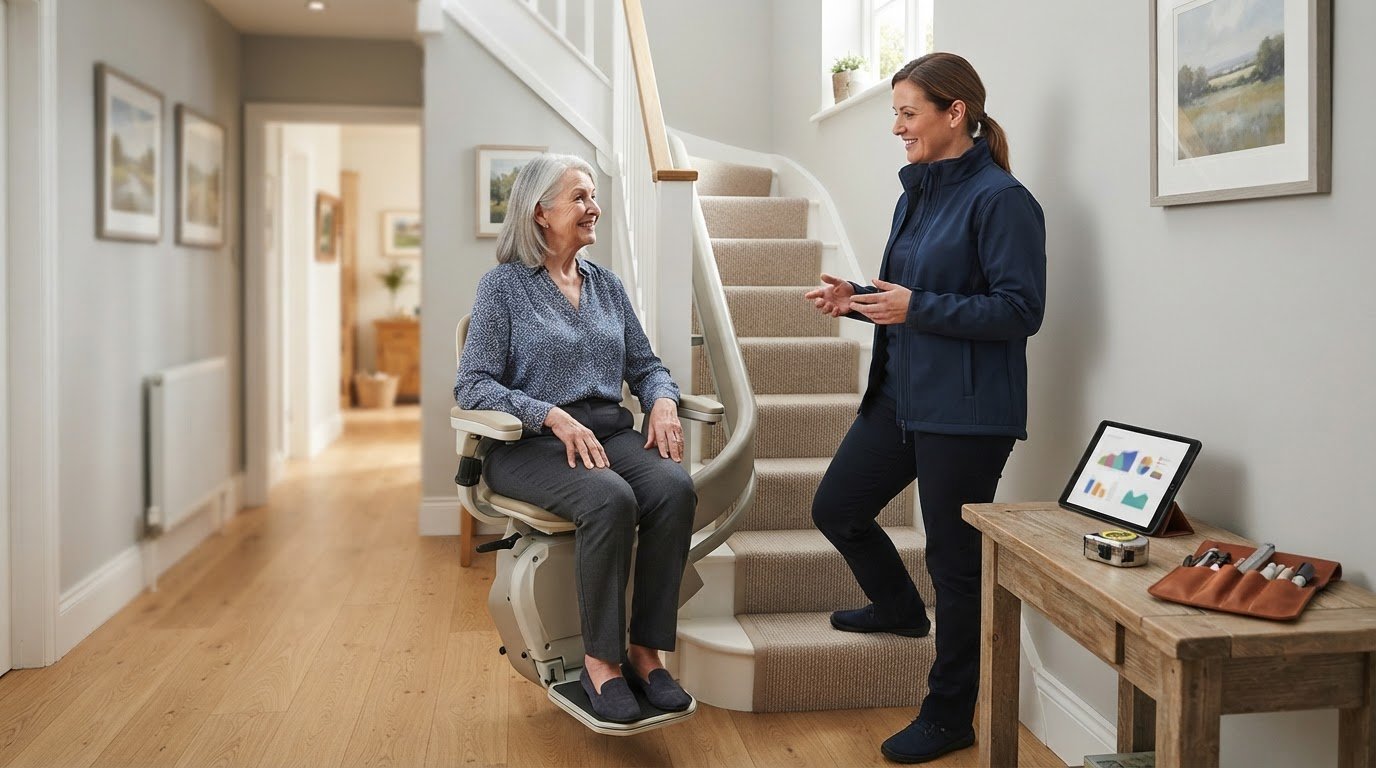
Prepare for a stairlift assessment on wooden stairs
A little preparation can make an assessment more useful. Clear photos and a list of questions help the installer understand the staircase and the person who will use the lift. They can also help you start a suitability discussion without treating an early conversation as a commitment to proceed.
Before the assessment, work through these steps:
Photograph the full staircase. Take clear views from the top and bottom, plus a view along the stairs so the full route is visible.
Capture details that may affect the route. Include turns, landings, nearby doors and the space at the top and bottom.
Point out visible wear. Photograph any loose, damaged or altered steps, and mention repairs or other concerns you have noticed.
Describe the user’s needs. Explain who will use the stairlift and any practical concerns, such as where they would find it easiest to get on and off.
Write down your questions. Ask about model suitability, proposed fixings, the fitting process and what the household should expect.
What staircase photos and details are useful?
Good photos show more than the wooden treads. Include the whole flight, turns and landings, as well as nearby doors that might affect available space. If a step looks worn or damaged, make sure it is easy to see and explain what you know about it. Photos can help an installer begin the conversation, but cannot confirm the staircase structure or replace a professional assessment.
For broader guidance, read the professional stairlift installation guide. It can help you understand why the proposed installation needs to be considered for your home, rather than judged from a general description of a stairlift for wooden stairs.
Questions to ask before agreeing to installation
Use the assessment to get clear answers before deciding. Ask whether the proposed model and fixing approach suit your wooden staircase, how the supporting structure will be checked, and what changes to the stairs or surrounding area to expect. If you have concerns about the finish or a repaired step, raise them before agreeing to installation.
You can also ask what happens on fitting day and whether anything needs to be prepared in advance. The guide to what to expect during stairlift installation offers wider process guidance.
To begin a low-pressure discussion, request a free, no-obligation quote from ElevatedStairlifts by sending staircase photos via WhatsApp or email. Photos are a useful starting point. Model suitability and the fixing plan still need to be confirmed for your home.
Choose a suitable stairlift for wooden stairs with expert guidance
Choosing a stairlift for wooden stairs means considering the staircase structure and layout, the user’s practical needs and the requirements of a particular model together. Timber alone cannot confirm suitability. The installer should explain how the proposed option relates to your stairs and what fitting would involve.
ElevatedStairlifts installs the Thyssen Homeglide and Stannah 260. These are options to discuss, not automatic matches for every wooden staircase. Ask the installer to confirm whether either model suits your staircase and the person who will use it before making a decision.
How to compare a quote and proposed installation
Look for a quote and recommendation that address your actual staircase, rather than a general description of a standard installation. Check that the proposed model is named and that the installer has considered the stair layout, condition and user’s needs. If anything is unclear, ask for an explanation before agreeing to proceed.
Compare the detail and clarity of the assessment, not price alone. Ask the installer to outline the proposed fixing approach and identify any expected changes to the wooden stairs or nearby areas. You can also ask what servicing or support information is available, so you understand what to expect after installation without relying on assumptions.
What happens after you share staircase photos?
Photos can help start a conversation about your staircase and possible options. They may show the overall route, turns, landings and visible wear, giving you a practical way to raise initial questions. However, photographs do not confirm the condition of the supporting structure or establish whether a specific model is suitable. That requires an appropriate professional assessment.
You do not need to have every answer before making an enquiry. Ask what information is needed next, how the proposed model and fixing method will be checked, and what installation involves. Take time to consider the response and raise any concerns before deciding.
ElevatedStairlifts can provide a free, no-obligation quote when you send staircase photos via WhatsApp or email. It is a straightforward way to begin discussing your options, with final suitability still to be confirmed for your home. If you are ready to take that first step, request a free, no-obligation stairlift quote.
Take the next step towards a suitable stairlift
A stairlift for wooden stairs may be possible, but the right choice depends on more than the tread material. The staircase’s condition and layout, the user’s needs and the chosen model all need to be considered together. Ask an installer to confirm the fixing method and explain what fitting would involve before you decide.
ElevatedStairlifts provides stairlift installation and support across the UK, with the Thyssen Homeglide and Stannah 260 available to discuss. Neither model is an automatic match. Suitability needs to be checked for your individual staircase.
You can begin by sending staircase photos via WhatsApp or email to request a free, no-obligation quote. It is a straightforward way to raise your questions and explore possible options without pressure to commit.
Request a free, no-obligation quote for your staircase and take the next step when you feel ready. A clear assessment can help you make a more confident decision for your home.
Frequently Asked Questions
Does a stairlift need to be fixed to the wooden steps?
Not necessarily. The fixing method depends on the stairlift model and staircase. Some designs have a rail fixed to the treads, but this is not universal. Ask the installer to identify the proposed fixing points and explain how they will check the staircase structure. Confirm the method for the specific model before agreeing to installation, rather than relying on a general description or assuming all stairlifts attach in the same way.
Will installing a stairlift damage wooden stairs?
Installation involves fixing equipment in place, so marks or holes may be left depending on the model and method. That is not the same as accidental damage, and a damage-free result should not be guaranteed. Before work begins, ask where fixings will go, what changes to the stairs or surrounding area to expect, and how the staircase will be protected and inspected during fitting. Raise concerns about the finish or previous repairs in advance.
Can a stairlift be fitted to wooden stairs with a landing or turn?
It may be possible, but turns and intermediate landings affect the rail route and the space needed for the lift to travel. The installer should assess the complete journey, including the approach to the stairs and the areas at both ends, rather than looking only at the treads. Ask how the proposed model could accommodate your layout and whether the full route has been considered before making a decision.
How do I know whether my wooden staircase is strong enough for a stairlift?
A professional assessment is the way to check. Appearance alone cannot confirm whether a staircase is suitable. The installer should consider tread condition, stability and supporting structure, as well as the fixing requirements of the model being considered. Point out loose, damaged, repaired or altered steps, even if the issue seems minor. Ask the installer to explain how these details affect the proposed installation and whether further checks are needed.
Can I get a stairlift quote by sending photos of my wooden stairs?
Yes. ElevatedStairlifts offers a free, no-obligation quote request using staircase photos sent by WhatsApp or email. Clear images of the full flight, turns, landings and any visibly damaged steps can help start a conversation about possible options. Photos do not replace a professional assessment or confirm that a particular model will suit your home, so ask what further checks are needed before deciding.
How much does a stairlift for wooden stairs cost?
There is not enough information here to give a reliable price for a stairlift for wooden stairs. The appropriate model and installation requirements need to be considered for the individual staircase, so request a quote based on your home rather than relying on a general figure. ElevatedStairlifts offers a free, no-obligation quote request using staircase photos sent by WhatsApp or email. Ask what the quote includes and which model it covers.
Comments