Stairlift Price Guide UK: 2026 Costs and Buying Advice
What if the most stressful part of regaining your independence indoors wasn't fitting the equipment, but getting a straight answer about the cost? If you feel uneasy about inviting commissioned salespeople into an elderly relative's home, or fear unexpected charges for awkward bends and electrical alterations, you're certainly not alone. Most families simply want transparent advice and reliable support. This stairlift price guide UK cuts through opaque industry jargon to explain what actually shapes overall expenditure, keeping your comfort and reassurance front and centre.
You'll discover what truly drives stairlift pricing across the UK and learn how to secure an honest, pressure-free quote without enduring doorstep sales tactics. We examine the mechanical differences between straightforward flights and bespoke curved staircases, clarify whether complex layouts require specialised engineering, and highlight the ongoing value of dedicated servicing. By the end, you'll have the confidence to evaluate equipment specifications clearly, finding a sensible path forward entirely on your own terms.
Table of Contents
Understanding UK Stairlift Costs: Straight vs Curved Rail Fundamentals
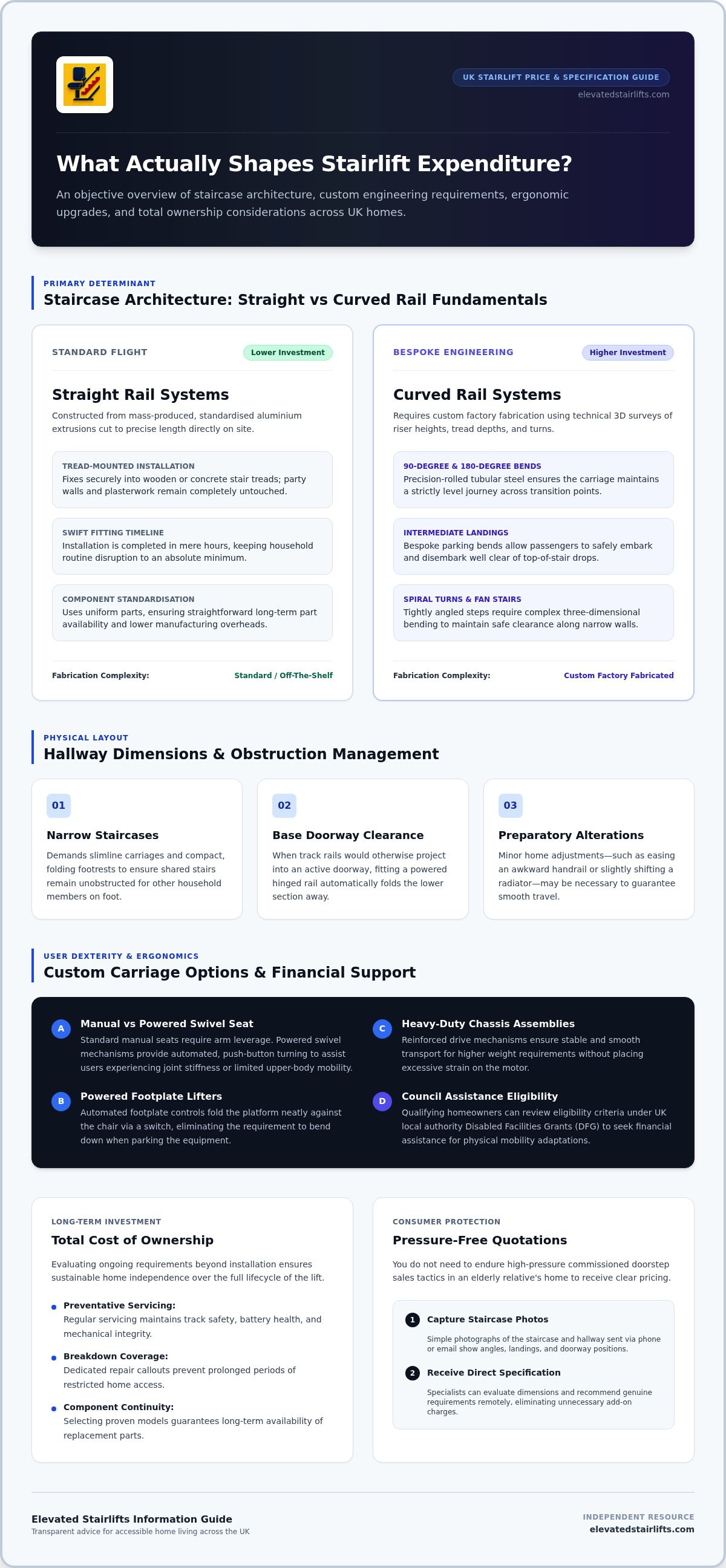
Staircase shape serves as the primary determinant for your overall equipment expenditure. Many online guides publish misleading teaser figures that fail to reflect practical realities, causing unnecessary frustration for families seeking clear advice. In this stairlift price guide UK homeowners can rely on, the key distinction rests between mass-produced straight tracks and bespoke engineering tailored to complex architecture.
The Mechanics of Straight Rail Installations
Straight staircases represent the simplest design scenario. Manufacturers construct straight tracks from standardised aluminium extrusions, allowing engineers to cut the rail to length on site. These systems mount securely into the wooden or concrete stair treads, never fixing into party walls or damaging your plasterwork. Because the components are uniform, installation is swift, often taking mere hours with minimal disruption to your daily routine. Understanding the technical differences across straight and curved stairlift mechanisms shows why straight models require fewer bespoke components; this keeps manufacturing investment lower while ensuring straightforward long-term part availability.
Why Curved Stairlifts Require Custom Engineering
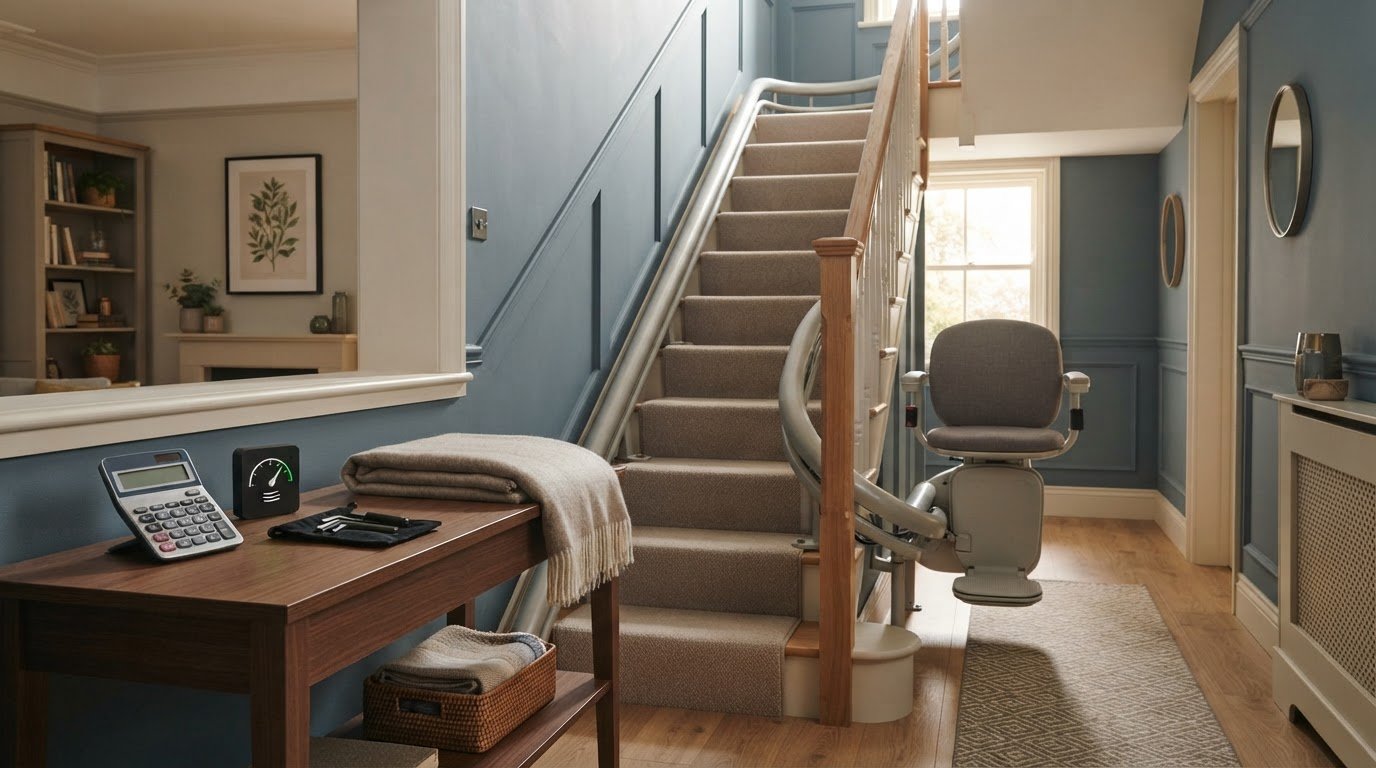
Curved staircases demand an entirely different manufacturing approach. No two curved staircases share identical dimensions, meaning off-the-shelf tracks simply can't provide a safe, level journey. Instead, technical surveyors map every angle using precise measurement tools to record individual riser heights, tread depths, and turns.
Factory fabricators use these precise measurements to produce tubular steel rails tailored specifically to your home. Several layout elements directly influence design intricacy:
90-degree and 180-degree bends: Sweeping turns require precision-rolled curves to ensure the carriage travels level throughout transition points.
Intermediate landings: Flat resting areas between flights often require bespoke parking bends so you can safely disembark away from the top of the stairs.
Spiral turns and fan stairs: Tightly angled steps demand complex three-dimensional rail bending to maintain safe passenger clearances along narrow walls.
This intensive design phase, custom factory fabrication, and rigorous quality testing explain why curved installations require greater investment than straightforward tracks.
Key Architectural and Physical Factors That Influence Your Stairlift Investment
Every home presents a unique layout, meaning equipment specifications must adapt to your individual hallway rather than the other way around. In this stairlift price guide UK readers will see how physical surroundings and personal physical requirements interact directly to shape installation choices. Identifying these factors early prevents unexpected adjustments during fitting, ensuring your independence is restored without unnecessary stress.
Staircase Dimensions and Obstruction Management
Narrow staircases often call for slimline carriages and compact, folding footrests to preserve clear walking passage for other family members. Doorways situated immediately at the base of the stairs pose another common hurdle. When a standard track would project into an active walkway, fitting a powered hinged rail allows the bottom section to fold automatically out of the way. Additionally, minor preparatory steps, such as easing an awkward handrail or slightly shifting a radiator, help ensure seamless travel along the entire flight. For homeowners exploring broader barrier-free layouts alongside their stairlift, dedicated accessibility providers such as HomeSafe Living Solutions demonstrate how comprehensive home modifications can improve day-to-day safety throughout the rest of the property.
Personal comfort and physical dexterity determine the level of automation required on the carriage itself. While a standard manual swivel seat suits many individuals, an automated powered swivel mechanism offers gentle, push-button turning for anyone with joint stiffness or reduced upper-body leverage. Powered footplate lifters also eliminate the need to bend down when tucking the chair away. For individuals requiring reinforced chassis support, specialist heavy-duty drive assemblies maintain smooth travel without straining the motor. Homeowners exploring local council support can review eligibility criteria under Disabled Facilities Grants to see if financial assistance applies to their specific physical requirements.
Electrical Supply and Charging Infrastructure
Modern stairlifts run on internal rechargeable battery packs that draw continuous trickle power from a domestic wall point. If your hallway lacks an adjacent power point, an installation specialist neatly extends discreet wiring from the nearest socket to ensure the rail charging points remain fully active. You can explore these electrical and fitting preparations in our comprehensive stairlift installation guide. If you ever want clear guidance on how your specific home dimensions affect equipment selection, the friendly specialists at ElevatedStairlifts are always ready to help you plan without pressure.
Evaluating Total Cost of Ownership: Warranties, Servicing, and Repairs
Looking at the initial equipment price tag tells only half the story. A comprehensive stairlift price guide UK families can rely on must account for ongoing reliability, safety inspections, and dependable breakdown support. A home lift quickly becomes a vital daily lifeline. Budgeting sensibly for preventative upkeep guarantees continuous mobility, preserves mechanical integrity, and prevents stressful emergency call-outs.
Understanding Warranty Coverage and Aftercare Value
Warranty terms vary considerably across the mobility sector. Basic manufacturer guarantees often cover replacement parts only, leaving you responsible for call-out charges and engineer labour. In contrast, comprehensive aftercare protection covers parts, labour, and priority assistance, giving you complete reassurance if an unexpected fault develops. Independent consumer research like Which? stairlift buying and brand advice consistently stresses the value of checking warranty small print. Attempting DIY fixes or using untrained handymen can invalidate manufacturer guarantees, making accredited professional care essential.
The Financial Value of Routine Servicing and Safety Inspections
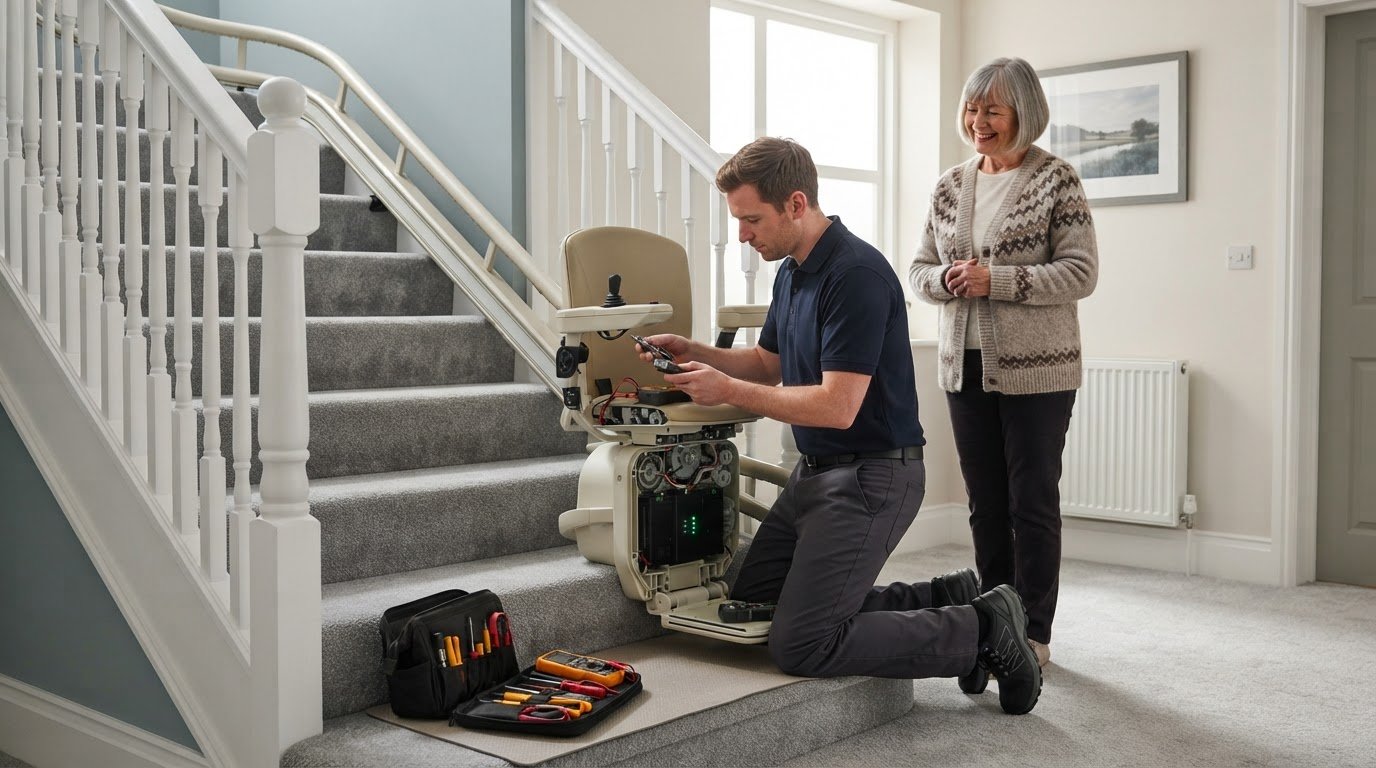
Regular servicing prolongs motor life and keeps essential mechanical components running smoothly. During a planned maintenance visit, a qualified engineer inspects the rack-and-pinion drive, cleans internal charging contacts, and tests emergency overspeed brakes. Internal battery packs naturally degrade over several years of continuous use. Scheduling routine battery health checks ensures replacements occur before an unexpected power failure strands the carriage. Discover practical tips for preserving mechanical longevity in our guide to stairlift maintenance.
Managing Emergency Repairs and Component Replacement
Even premium equipment experiences natural wear on sensitive safety sensors, guide rollers, and electronic circuit boards over time. Addressing minor warning signals early prevents widespread damage to the primary drive assembly:
Obstruction sensor faults: Sensitive footrest edges may trigger unexpectedly, halting travel until reset.
Charging contact wear: Dirty or misaligned copper pickups prevent batteries from holding a full charge at parking points.
Motor strain: Subtle unusual sounds often signal that roller assemblies require cleaning and realignment.
Rapid fault diagnosis keeps minor component wear manageable. If your lift develops an unexpected fault, consult our dedicated stairlift repair overview for guidance on restoring dependable daily operation.
How to Obtain an Accurate, Pressure-Free Stairlift Quote in the UK
Securing a dependable quotation shouldn't involve high-pressure sales pitches in your living room. Following this stairlift price guide UK process allows you to gather realistic advice whilst protecting your peace of mind and personal space:
Step 1: Document the staircase layout: Take clear photographs from the top, middle, and bottom of the flight, highlighting nearby doorways or radiators.
Step 2: Detail user requirements: Note specific mobility needs, such as limited knee flexion, swivel seat preferences, or preferred hand controls.
Step 3: Submit images digitally: Share photos via WhatsApp or email for remote technical appraisal.
Step 4: Review a written proposal: Take time to evaluate an itemised quote alongside family members, completely free from doorstep sales pressure.
The Advantages of Remote Photo Quoting
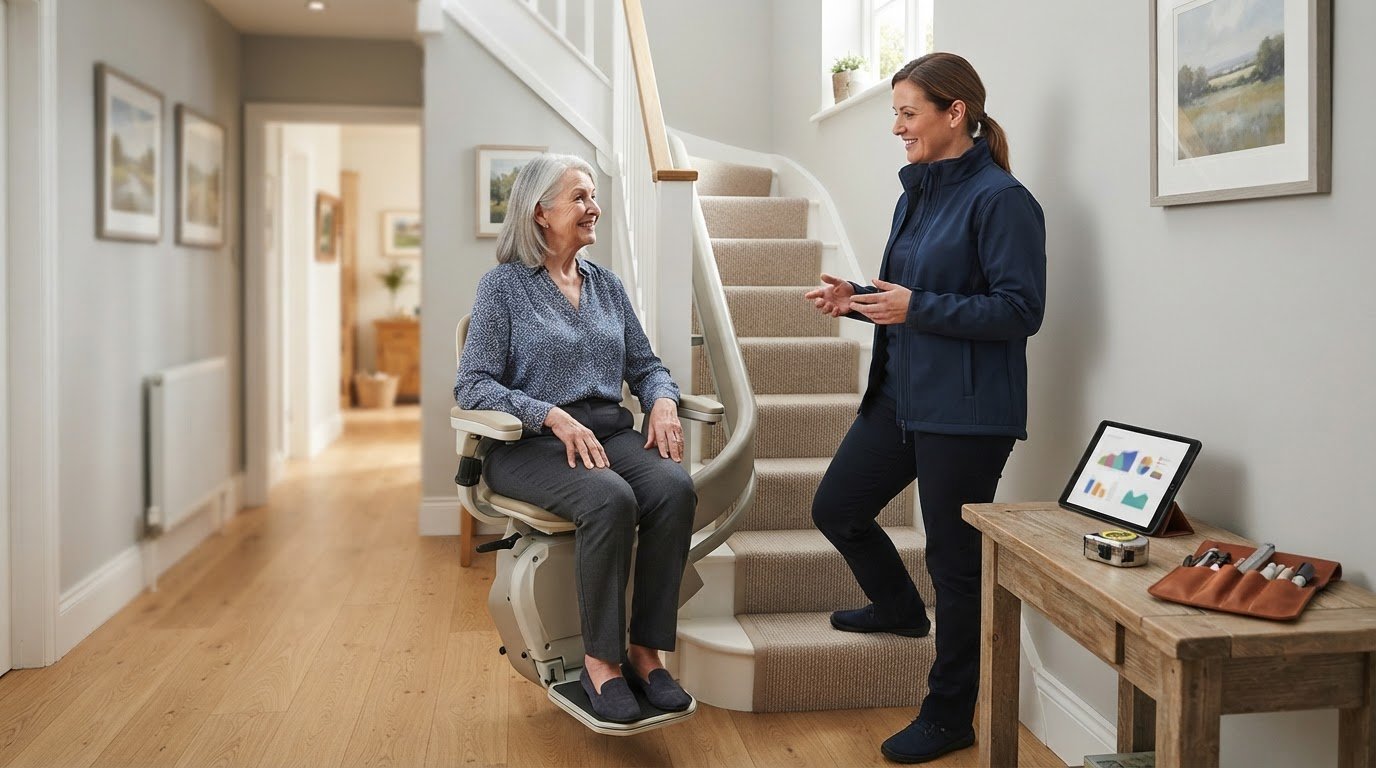
Traditional mobility sales models rely on lengthy home visits, often leaving elderly residents feeling pressured to sign contracts on the spot. Modern remote surveys eliminate that discomfort entirely. By sending clear staircase pictures from your phone, experienced technical specialists can evaluate riser angles, landing returns, and obstacle clearances accurately. You retain full control over the conversation, allowing your family to deliberate quietly without an uninvited salesperson sitting at your dining table.
What to Look for in an Itemised Quotation
A transparent quotation leaves zero room for ambiguity. Check that the proposal covers complete fitting labour, safety testing to British standards, electrical wiring, and cleanup. Clear terms regarding warranty duration and ongoing breakdown support should be spelled out plainly. Never accept vague estimates that leave room for extra charges on fitting day.
Exploring Funding and Council Assistance Options
Homeowners should also investigate statutory financial relief before committing to private funding. If you live with a physical disability or long-term medical condition, you qualify for zero-rated VAT under HMRC regulations, saving 20% across both equipment and installation via a simple declaration. You can also contact your local council regarding Disabled Facilities Grants, though occupational therapy assessments often involve lengthy waiting periods.
Ready to evaluate your options without high-pressure tactics? You can request a free photo quote from ElevatedStairlifts today by sending simple staircase photos via WhatsApp or email for prompt, transparent advice.
Selecting Proven Models for Long-Term Home Independence
Investing in a stairlift is about securing lasting comfort and peace of mind. While generic hardware might seem tempting on paper, choosing proven, established systems ensures that replacement components remain readily accessible and technicians possess deep familiarity with your equipment. Leading British and European manufacturers design machines capable of handling years of daily use while complying strictly with British safety standards. For a broader look at market-tested models, explore our overview of UK home stairlift solutions.
Thyssen Homeglide: The Gold Standard for Straight Stairs
For straight staircases, the Thyssen Homeglide stands out as a dependable workhorse. Its slender rail profile is ideally suited to traditional British terraced and semi-detached properties, leaving generous foot space for others using the stairs. Built with durable upholstery and an ergonomic, intuitive joystick, it delivers effortless control for individuals with limited grip strength. Gentle start-and-stop motion protects delicate joints from sudden jolts, making every trip between floors smooth and reassuring.
Stannah 260: Precision Engineering for Intricate Curves
When a staircase features turns, half-landings, or fan-shaped steps, Stannah 260 installation provides bespoke engineering designed specifically for complex geometries. Its twin-rail architecture hugs the wall tightly, maximising clear stairway access whilst maintaining rock-solid stability around sharp bends. The carriage features comprehensive safety sensor arrays that gently halt travel should an obstruction arise. With versatile seat configurations and upholstery styles, this model integrates seamlessly into your home without looking clinical.
Nationwide Professional Installation and Long-Term Partnership
Equipment quality only matters if fitted correctly. Every reliable stairlift price guide UK homeowners consult should emphasise the critical role of professional, compliant fitting. Qualified engineers ensure that every support bracket, rail joint, and electrical trickle charge connection meets strict safety regulations. Long-term independence also relies on having dependable support if mechanical faults ever occur. With comprehensive national coverage, regular preventative servicing and reliable breakdown service protect your mobility day after day. Whenever you feel ready to take the next step, contact ElevatedStairlifts to arrange a clear, pressure-free evaluation tailored to your household.
Taking the Next Step Towards Safe Home Independence
Navigating home modifications should bring relief, not stress. As shown throughout this stairlift price guide UK homeowners can rely on, securing the right mobility solution comes down to understanding your staircase architecture, selecting proven hardware, and prioritising ongoing maintenance over hasty upfront promises. Whether your home accommodates a straightforward flight or requires bespoke curved engineering, having clear information empowers you to decide with total confidence.
You don't need to endure pushy salespeople in your living room to get honest answers. As certified specialists in Thyssen Homeglide and Stannah 260 installations, ElevatedStairlifts pairs rapid remote quotes via WhatsApp with zero doorstep pressure, backed by comprehensive nationwide breakdown support and routine maintenance. Regaining smooth, comfortable access to every floor of your house is entirely within reach. Request your free, no-obligation quote by sending staircase photos to ElevatedStairlifts today, and take the next step towards effortless daily living on your own terms.
Frequently Asked Questions
How much does a straight stairlift cost compared to a curved model in the UK?
Straight stairlifts require significantly less investment than curved models because they use standardised, factory-extruded aluminium rails that engineers cut to length during fitting. Curved staircases require custom-fabricated tubular tracks engineered specifically to match individual bends, turns, and landing layouts. In any transparent stairlift price guide UK homeowners review, the custom manufacturing, technical 3D surveying, and extended workshop fabrication make curved systems inherently more substantial investments than standard straight designs.
Can I get financial help or a council grant towards my stairlift in the UK?
Yes, UK homeowners and tenants can apply for council-funded Disabled Facilities Grants to help finance essential accessibility adaptations. Your local authority requires an assessment by an occupational therapist to confirm the lift is necessary and appropriate for your medical condition. These grants are means-tested for adults based on household income and capital. Because council grant processing can take several months, many families choose private installation to restore safe access without delay.
Do I qualify for zero-rated VAT when purchasing a mobility stairlift?
Most individuals purchasing a domestic stairlift qualify for zero-rated VAT under HMRC regulations. If the lift is installed in a private home for someone living with a physical disability or long-term chronic condition, such as severe arthritis, Parkinson's, or heart disease, you don't pay standard VAT. Qualifying requires no formal doctor's letter; you simply sign a brief self-declaration form confirming eligibility when placing your order.
What happens if my stairlift breaks down or suffers a power cut?
Modern stairlifts run on dedicated rechargeable DC battery packs rather than drawing direct power while in transit. If a power cut strikes your neighbourhood, the battery reserve provides multiple complete journeys up and down the stairs. Should a mechanical issue arise, choosing a reputable provider with nationwide breakdown service and routine maintenance packages ensures qualified engineers quickly diagnose faults and replace worn components, keeping your daily independence secure.
How long does professional stairlift installation take once ordered?
Straight stairlifts can be scheduled and installed very quickly because tracks are prefabricated and adjusted on site, with physical installation taking roughly two to four hours. Curved installations take longer from order to completion, as bespoke rails require precision factory fabrication to fit unique staircase contours. Once delivered to your home, a specialist engineer fits and fully tests a curved system within a single working day with minimal domestic disruption.
Can a stairlift be installed on narrow or steep UK staircases?
Yes, modern engineering accommodates the compact dimensions typical of British architecture. Slimline models, such as the Thyssen Homeglide, feature folding footplates, compact seats, and slender rail profiles designed specifically to preserve clear stairway passage. For complex architectural turns and tighter corners, systems like the Stannah 260 offer bespoke dual-rail engineering and automated swivel seating, ensuring passengers glide safely past narrow stringers and bulkheads without catching their knees.
Is an in-person home survey mandatory to get an accurate price quotation?
An in-person visit isn't mandatory to obtain an accurate, reliable proposal. Modern remote assessments allow technical engineers to evaluate your staircase layout, landing turns, and potential doorway obstructions using clear photographs sent via WhatsApp or email. This stairlift price guide UK method spares your family from enduring high-pressure doorstep sales techniques, providing an itemised written quotation so you can evaluate equipment specifications comfortably and at your own speed.
Comments