The Complete Guide to Professional Stairlift Installation in 2026
Updated: Sep 3
What if you could reclaim every floor of your home without the stress of a major renovation project? For many, the thought of a stairlift installation brings up worries about dusty construction, damaged banisters, and complicated machinery. You likely want to stay in the house you love, but the stairs have started to feel like a barrier to your independence. It's perfectly normal to feel anxious about how a lift will look in your hallway or whether your specific staircase is even suitable for one.
We understand these concerns because we hear them from families every day. This guide is designed to give you total peace of mind by walking you through the entire process, from initial precision measurements to final safety checks. You'll learn how modern rails are fitted directly to the treads rather than the wall, which protects your decor. We'll also explain how battery-powered systems now provide 10 to 20 trips even during a power cut, ensuring you're never left stranded. By the end, you'll have a clear, fuss-free path to restoring your autonomy and moving freely around your home again.
Table of Contents
Understanding the Professional Stairlift Installation Process
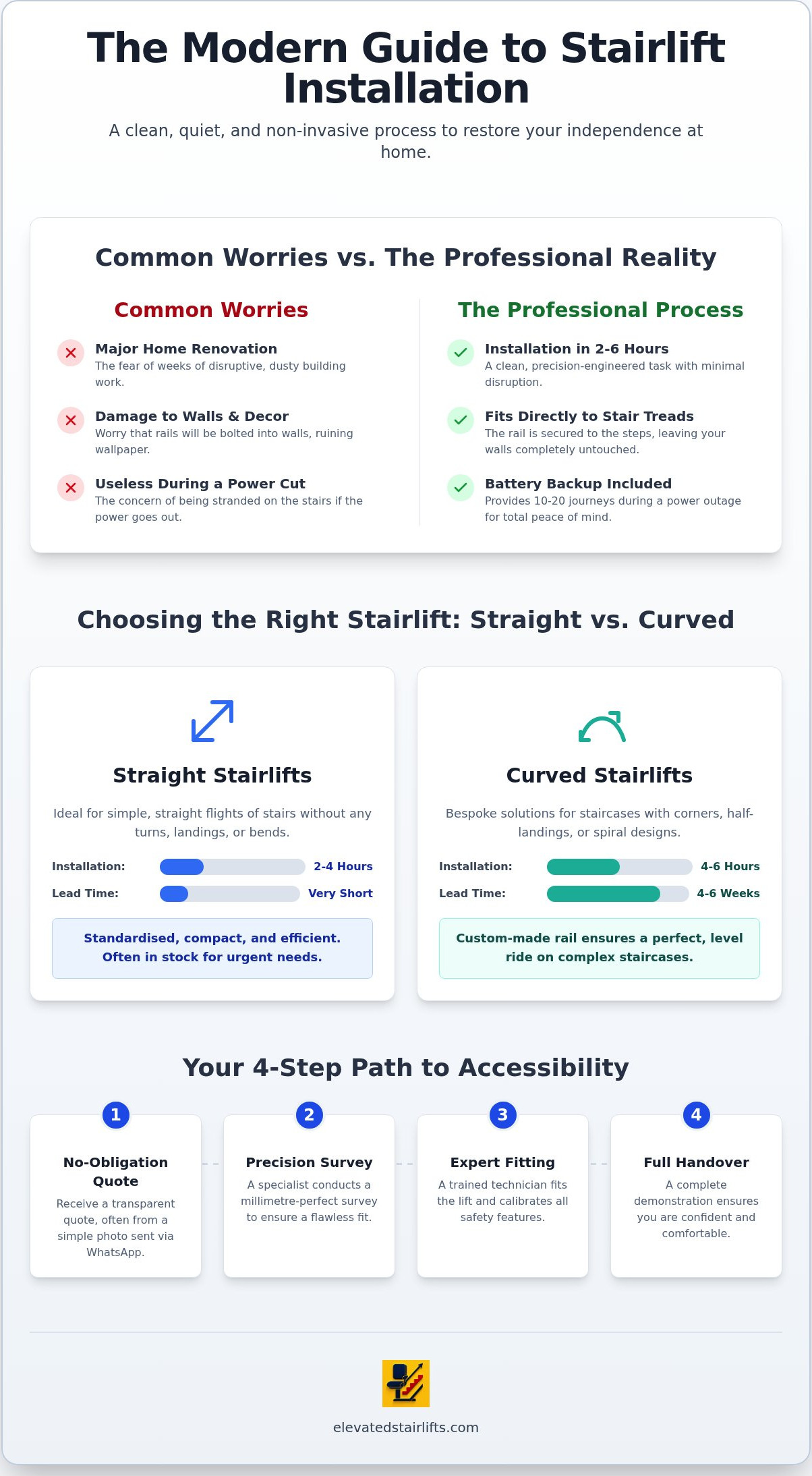
Many people imagine that getting a lift fitted involves weeks of dusty building work and structural changes to their home. In reality, a professional stairlift installation is a clean, technical task that feels more like precision engineering than a traditional building project. It's a non-invasive process designed to respect your home's existing decor whilst providing a vital boost to your independence. Before any equipment arrives, a specialist conducts a detailed pre-installation survey. This ensures every component is manufactured to a millimetre-perfect standard, which is the secret to a smooth and reliable ride.
On a typical UK staircase, the physical fitting usually takes between two and six hours. This efficiency is possible because the rail is designed to be fixed directly to the stair treads, never the wall. For a broader stair lift overview, it's helpful to recognise that this method protects your wallpaper and avoids the need for messy structural reinforcements. Choosing a professional installer isn't just about convenience; it's the only way to ensure your manufacturer warranty remains valid and that the equipment meets all necessary safety standards.
The Role of the Stairlift Fitter
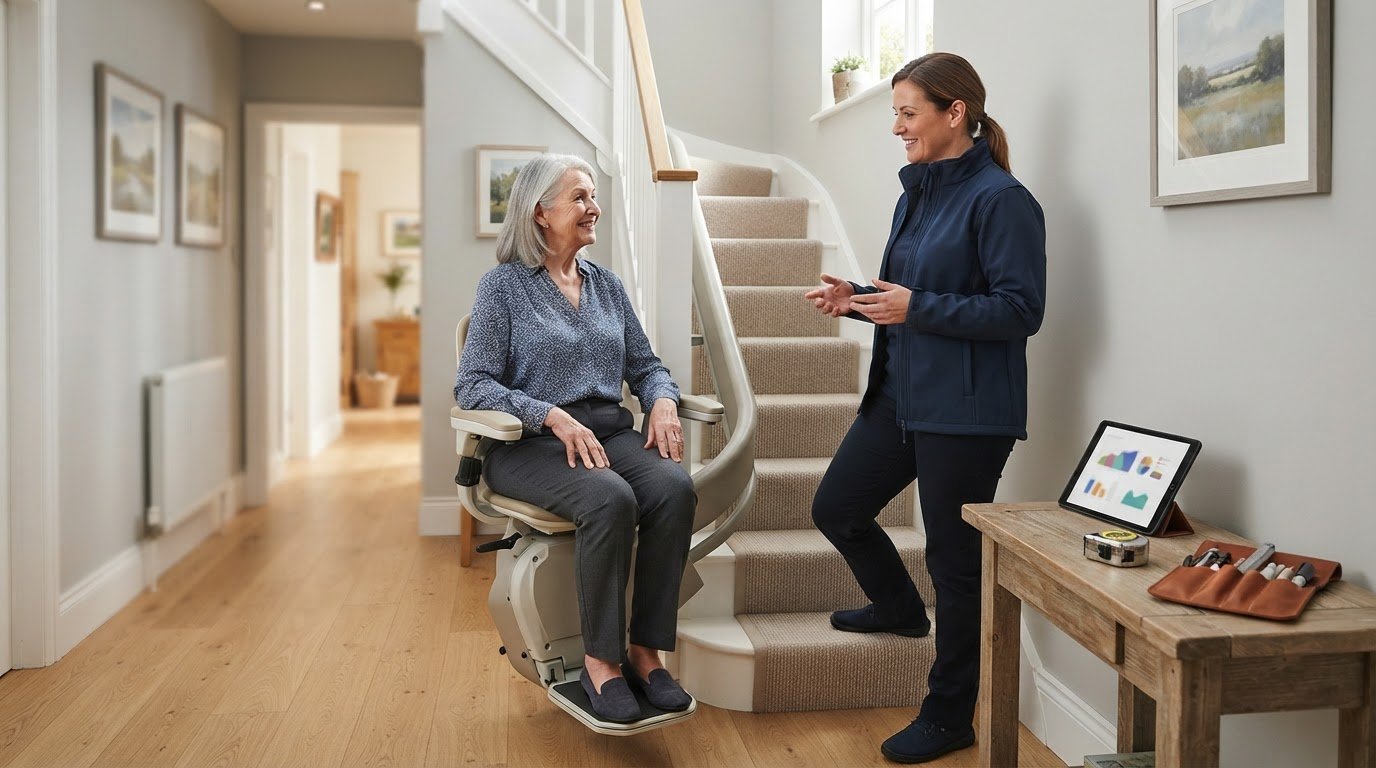
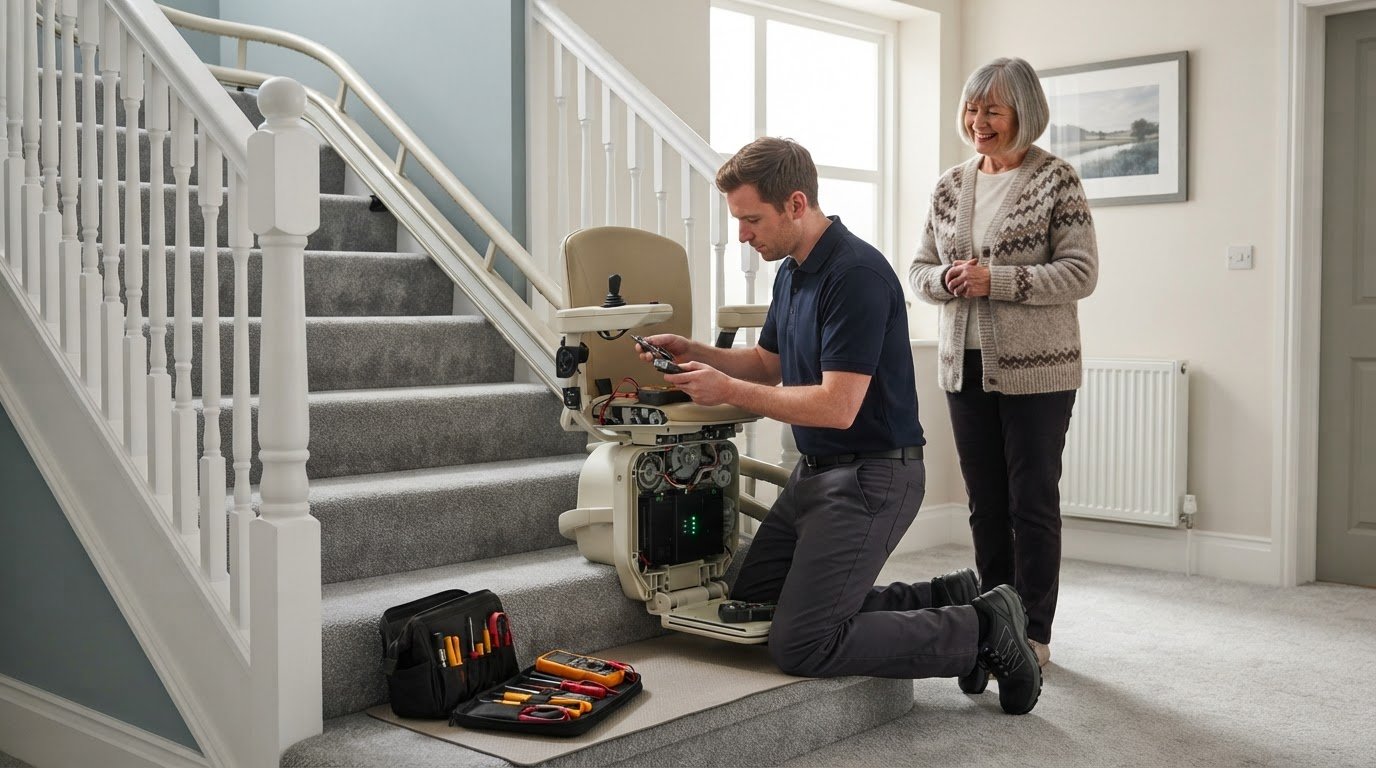
The technician visiting your home is a specialist with deep technical expertise. Their role goes far beyond simply bolting parts together. They're responsible for calibrating sensitive safety sensors and setting precise motor limits so the chair stops exactly where it's supposed to. They spend time fine-tuning the rail alignment to ensure your journey is whisper-quiet every single time. Once the mechanical work is finished, the fitter provides a patient and supportive handover. They'll stay with you for as long as you need, teaching you how to use the controls with total confidence and making sure you feel completely comfortable before they leave.
Safety Standards and Regulations in the UK
Your safety is the absolute priority during every fit. All professional work must adhere to strict British Safety Standards for domestic mobility equipment. One of the most critical requirements is ensuring the rail is secured firmly to the stairs, which provides the necessary structural integrity for the lift to operate safely. Before the job is signed off, the installer carries out a series of rigorous tests. This includes a full weight-capacity check and a battery-backup verification. Because modern models like the Thyssen Homeglide or Stannah 260 rely on high-quality batteries, they'll continue to work even during a power cut, ensuring you're never left stranded on the stairs.
Straight vs Curved Stairlift Fitting: Key Differences
The shape of your staircase is the single biggest factor in determining the complexity of your stairlift installation. Whilst both types provide the same outcome of safety and freedom, the engineering behind them differs significantly. Straight stairlifts are designed for simple runs without turns or landings, making them a quick and efficient solution. In contrast, curved systems are bespoke pieces of equipment, manufactured to follow the unique contours of your home.
For straight stairs, the Thyssen Homeglide is often the preferred choice. It's celebrated for its slimline design and rapid fitting process. Because straight rails use standardised components, the lead time from your first enquiry to the final fit is often very short. Most straight installations are completed in under half a day, meaning your routine is barely interrupted. If you're unsure which category your staircase falls into, you can easily get a professional opinion to help you decide.
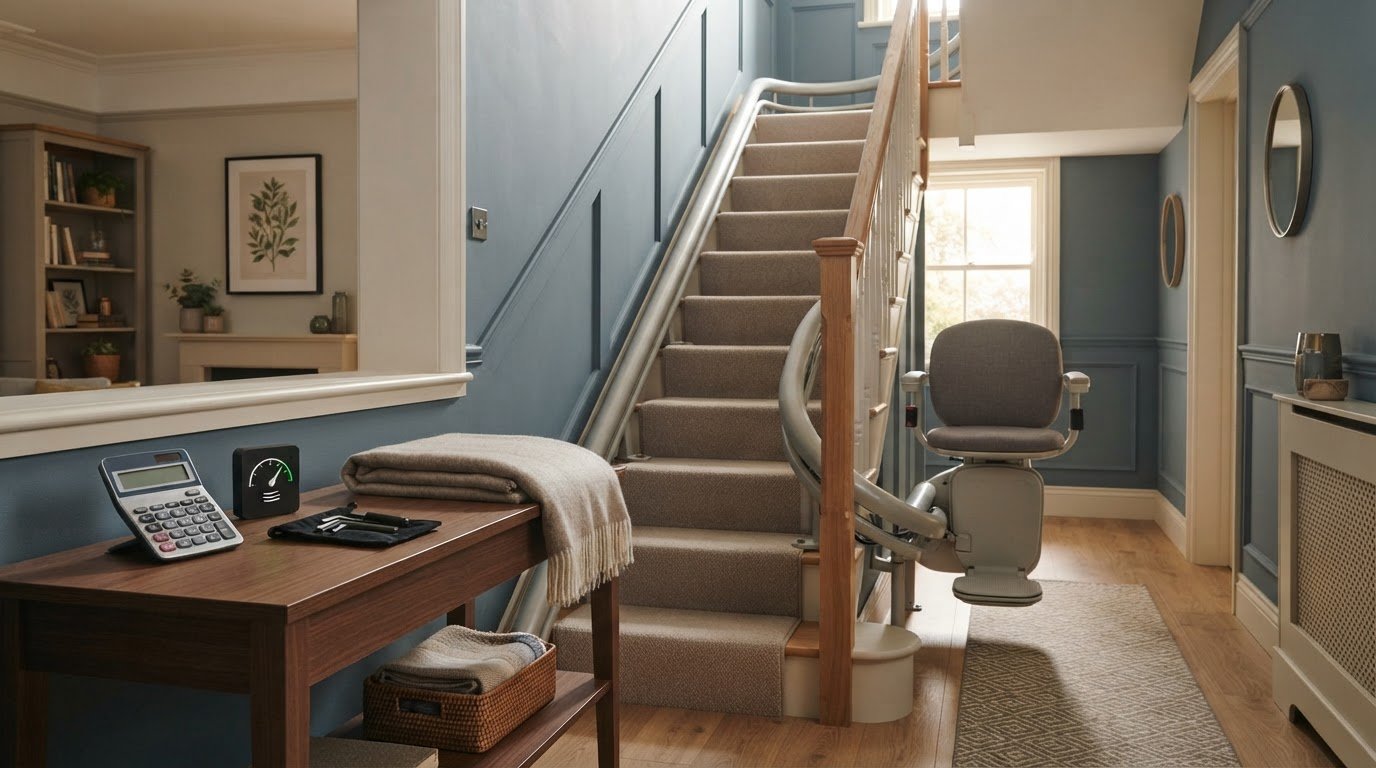
A curved stairlift installation requires a more meticulous approach. These systems must navigate corners, half-landings, or even spiral designs. Because the rail is custom-made, there is a manufacturing period involved. Data from the industry suggests that curved rail fabrication can take between four and six weeks due to the precision laser-measurement required. Once the bespoke rail arrives, expert fitters ensure the carriage remains perfectly level as it traverses complex gradients.
Straight Rail Installation Simplified
If your stairs go from top to bottom in one single line, you're looking at a straightforward process. Straight rails are often kept in stock, allowing for a swift response when mobility becomes an urgent priority. The Thyssen Homeglide excels here, offering a compact profile that leaves plenty of room for other family members to walk up and down the stairs. It's a low-fuss option that restores your independence in just a few hours without the need for custom fabrication.
The Art of the Curved Stairlift Fit
Complex stairs with multiple landings or steep turns require the technical sophistication of a Stannah 260 installation. The process involves placing support pillars on the stair treads, which can be done on almost any surface including wood, concrete, or steel. These pillars are strategically positioned to provide maximum stability without obstructing the walkway. The most impressive part of a curved fit is the carriage calibration. The motor is programmed to adjust the seat angle constantly, ensuring you feel secure and upright even when the rail takes a sharp turn or changes pitch.
Preparing Your Home for a Stairlift Fitter
One of the most frequent questions we hear from homeowners is whether their interior design will survive the fitting process. It's a natural concern; you've spent years decorating and caring for your house. You'll be pleased to know that a professional stairlift installation is remarkably clean and respectful of your property. Because the rail is secured directly to the stair treads rather than the wall, your wallpaper, paintwork, and plaster remain completely untouched. Expert fitters arrive prepared with protective floor coverings to shield your carpets from any foot traffic or small amounts of dust during the work.
The goal is to ensure that once the job is finished, the only change you notice is your newfound freedom of movement. Fitters are trained to work methodically and quietly, organising their tools to minimise disruption to your daily routine. They'll also carry out a thorough tidy-up before they leave, ensuring your hallway is as neat as it was when they arrived. This focus on home integrity is a hallmark of a high-quality service that prioritises your emotional well-being alongside your physical mobility.
Dealing with Obstructions and Narrow Stairs
Before your installation date, it's helpful to look at the area around your staircase for any potential hurdles. Narrow hallways or stairs with limited width are common in many UK homes, but they rarely prevent a successful fit. Slimline models are designed to fold up neatly, leaving plenty of space for other family members to use the stairs normally. If you have a radiator located at the very bottom or top of the flight, don't worry. In most cases, the rail can be designed to start just past the obstruction, or a minor plumbing adjustment can be made to create the necessary clearance. If a doorway at the top of the stairs seems like it might be blocked, a "hinged rail" solution can be used to keep the walkway clear when the lift isn't in use.
Electrical Requirements and Power Points
The electrical side of the process is simpler than many people expect. You won't need an expensive or messy rewiring project. A standard UK 13-amp plug socket is usually all that's required to power the system. Whilst the lift itself runs on DC battery power to ensure a smooth and consistent ride, it needs a constant AC connection to keep those batteries topped up. The fitter will identify the nearest socket and ensure the charging points at the top and bottom of the rail are perfectly aligned. This setup provides total peace of mind, as the battery backup ensures the lift remains fully operational even during a power cut.
The WhatsApp Photo Quote Advantage
One of the easiest ways to start your journey is by using a simple WhatsApp photo quote. This low-friction method allows you to get an immediate, no-obligation estimate without anyone needing to enter your home. To get the best results, you'll need to provide a few specific angles of your staircase. Start by taking a clear photo from the bottom looking up, and another from the top looking down. If your stairs have a landing or a curve, include a shot that shows those features clearly.
These digital photos are incredibly helpful for engineers. They can identify potential fitting issues, such as the position of a radiator or a narrow doorway, long before the installation date. This early insight reduces stress and ensures that the equipment ordered is the perfect match for your home's layout.
Comparing Stairlift Installation Companies
When you're looking for a reliable partner, transparency and reviews are your best tools. A trustworthy company will be open about their processes and have a track record of supporting their clients. It's also vital to check if the company specialises in high-quality models like the Thyssen Homeglide or the Stannah 260. These models require expert fitting to ensure they operate at peak performance.
You should also ask about the long-term support on offer. Is the breakdown service managed in-house, or is it outsourced to a third party? Choosing a provider with a dedicated, in-house team ensures that if you ever need help, you'll be speaking to people who know your lift inside and out. To see how easy it is to get started with a professional estimate, you can send your staircase photos for a quote.
Post-Installation Care: Maintenance and Breakdown Support
The successful completion of your stairlift installation is a significant milestone in reclaiming your independence. It's the moment the stairs stop being a source of stress and become just another part of your home again. However, it's helpful to view the fitting as the start of a long-term journey rather than the final destination. Like any precision-engineered machine that you rely on daily, a stairlift requires a small amount of ongoing care to ensure it remains a safe and whisper-quiet companion for years to come.
Maintaining your lift isn't just about protecting your investment; it's about protecting your autonomy. When you know your equipment is in top condition, you can move between floors with total peace of mind. Modern systems are incredibly robust, but regular check-ups allow engineers to spot minor wear and tear before it affects your routine. This proactive approach is the best way to ensure the results of your stairlift installation remain as reliable as the day it was fitted.
Routine Maintenance for Longevity
A professional stairlift service is a thorough process that goes far beyond a simple visual check. During a visit, a specialist engineer will inspect the motor's performance, test the safety gear, and examine the rollers for any signs of wear. They'll also check the battery health to ensure you still have that vital 10 to 20 trips of backup power in the event of a cut. For high-quality models such as the Stannah 260 or Thyssen Homeglide, we recommend a professional service at least once a year.
In between these visits, there are simple tasks you can do yourself to help. Keeping the rail clean is the most effective way to prevent issues. Whilst the lift is designed for heavy use, dust or pet hair can accumulate on the track, which might eventually affect the smoothness of the ride. A quick wipe with a dry, lint-free cloth once a week is usually all that's needed to keep the carriage gliding perfectly.
Handling Emergencies and Breakdowns
Even with the best maintenance, unexpected issues can occasionally occur. Most modern lifts now feature a helpful diagnostic display, often located on the armrest or the carriage. If the lift stops moving, this display will show a specific code. This is a brilliant tool because it allows you to communicate the exact issue to an engineer over the phone, often leading to a much faster resolution. Knowing that expert breakdown support is only a phone call away provides an essential safety net for those who rely on their lift for every journey.
Ensure your independence is never interrupted - Explore our maintenance and repair services
Take the First Step Toward a More Accessible Home
Restoring your independence doesn't have to be a source of stress. A professional stairlift installation is a precise and respectful process. It protects your home's character whilst giving you the freedom to move between floors with confidence. Whether you require the slimline efficiency of a Thyssen Homeglide or the bespoke engineering of a Stannah 260, the solution is often much simpler than you might imagine.
Our team of empathetic engineers is dedicated to providing a gentle, supportive touch. As specialists in fitting the Thyssen Homeglide and Stannah 260, we guide you from the very first measurement to the final safety check. We also provide a national breakdown and repair service to ensure your peace of mind is never interrupted. You don't have to navigate this decision alone or deal with high-pressure sales visits. You can get a free, no-obligation stairlift quote via WhatsApp by simply sending us a few photos of your stairs. It's a transparent way to start your journey back to total autonomy. We're here to help you every step of the way.
Frequently Asked Questions
How long does a typical stairlift installation take?
A standard straight stairlift installation usually takes between two and six hours to complete. Because the rail is fixed directly to the stair treads rather than the wall, there's no need for major structural work or messy building projects. For curved staircases, the process is more complex and can take a full day. Our engineers work methodically to ensure your routine is barely interrupted whilst restoring your independence and comfort.
Will the stairlift be attached to my wall or the stairs?
Your stairlift is secured firmly to the stair treads, never the wall. This is a common misconception that often causes unnecessary worry for homeowners. By mounting the rail to the steps, we ensure the structural integrity of the lift whilst protecting your wallpaper and paintwork from damage. This method also makes the equipment much easier to remove or relocate in the future without leaving unsightly holes in your plaster or requiring expensive repairs.
Can a stairlift be fitted to a narrow staircase?
Yes, we can often fit a stairlift to even the most narrow UK staircases. Slimline models like the Thyssen Homeglide are specifically designed with a compact profile to leave plenty of room for other family members to walk up and down. The seat, arms, and footrest also fold up neatly when not in use. If you're concerned about space, sending a quick photo via WhatsApp is the easiest way for us to confirm suitability for your home.
Do I need to redecorate after the stairlift is installed?
No redecoration is required following a professional stairlift installation. Because our engineers fix the rail to the stairs and not the wall, your decor remains completely untouched. We also use protective floor coverings during the fitting process to shield your carpets from any dust or foot traffic. Once the work is finished, we perform a thorough tidy-up, leaving your hallway exactly as we found it, just with the addition of your new mobility solution and restored freedom.
What happens if there is a power cut whilst I am using the lift?
You won't be left stranded if the power fails. Modern stairlifts run on DC battery power, which is constantly charged by your home's electrical supply. In the event of a power cut, the onboard batteries typically provide between 10 and 20 additional trips. This ensures you can always reach the top or bottom of the stairs safely. Our engineers will test this backup system during the final safety checks to give you total peace of mind.
How much space is needed at the bottom of the stairs for the chair?
You generally need enough space for the chair to park safely without blocking a doorway or creating a trip hazard. A typical parking area requires about 60cm to 90cm of clearance from the bottom step. If your hallway is particularly tight or a door is in the way, we can install a powered folding rail. This clever feature automatically lifts the bottom section of the track out of the way when the lift isn't being used.
Can I still use my stairs for walking after the lift is fitted?
Yes, your stairs remain perfectly usable for everyone else in the household. The rail is fitted close to the edge of the steps to maximise the walking width. Additionally, the chair's seat, armrests, and footplate all fold up flat against the wall when the lift is parked. This ensures that the staircase remains clear and safe for foot traffic, maintaining a normal flow of movement throughout your home for the whole family to enjoy.
Is it possible to install a stairlift on a staircase with a radiator?
It is entirely possible to install a lift even if there is a radiator near the stairs. In many cases, the rail can be designed to start slightly further up the flight to avoid the obstruction. If the radiator is in a critical position, a minor plumbing adjustment can usually create the necessary clearance. We'll identify these details early during the photo quote process to ensure your journey is planned with absolute precision and care.
Comments